What influences coronary physiology in patients with severe aortic stenosis and coronary artery disease ?
European Heart Journal Supplements


Abstract
Coronary artery disease (CAD) is frequent in patients with severe aortic stenosis (AS) and physiology-guided treatment has been shown to reduce coronary events.
Factors that influence coronary physiological indices in AS are understudied and truly understanding them is essential to guide clinical practice.
In this prospective multicentric study, we performed serial measurements of epicardial and microvascular indices in 146 coronary lesions in patients with severe AS, before and 6 months after AVR.
Six-months after AVR FFR decreased and RFR increased significantly, while all microvascular parameters improved significantly. We observed a weak positive correlation between the RFR-FFR difference and the CFR (Pearson r = 0.350, p<0.001)(Fig.1A) but not with baseline IMR (Pearson r = 0.125, p=0.165)(Fig.1B).
Coronary lesions severity does not significantly influence the six-month change in FFR (Fig.1C-D). In contrast, coronary lesion severity influences the change in RFR (Pearson r = 0.663, p<0.001)(Fig.1E-F). Interestingly, a lower baseline MRR predicts a larger decrease in FFR (Pearson r = 0.232, p < 0.037)(Fig.2A) and larger increase in RFR (Pearson r = -0.223, p<0.047)(Fig.2B). Moreover, a larger increase in MRR was associated with a larger decrease in FFR (Pearson r = -0.231, p<0.041)(Fig.2C) and a larger increase in RFR (Pearson r = 0.233, p<0.042) (Fig.2D). CFR showed comparable relation to changes in FFR/RFR as MRR. In contrast, baseline and delta IMR did not have a significant relationship with the observed changed in FFR/RFR.
Both left ventricular end-diastolic pressure and trans aortic valve gradients had no impact on RFR (Fig.2F and 2H). In contrast, baseline LVEDPs (Pearson r = -0.367, p<0.030)(Fig.2E) and AV-gradients (Pearson r = -0.393, p <0.020)(Fig.2G) were both significantly correlated with delta FFR.
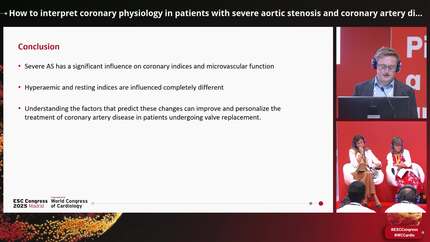
Severe AS significantly influences hyperaemic and resting indices completely different. Understanding the factors that predict significant changes can improve and personalize the treatment of CAD in AS.
Contributors


You may be interested in