Correlates and prognostic value of left atrial strain in transcatheter edge-to-edge repair for degenerative mitral regurgitation
European Heart Journal - Cardiovascular Imaging


Abstract
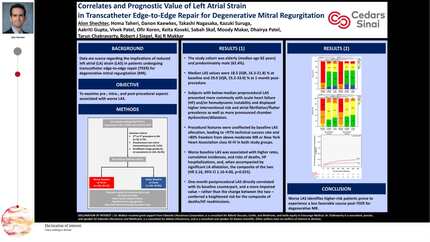
Data are scarce regarding the implications of left atrial (LA) strain (LAS) in patients undergoing transcatheter edge-to-edge repair (TEER) for degenerative mitral regurgitation (MR). We explored pre-, intra-, and post-procedural aspects according to LAS status in this setting.
A single-centre, retrospective analysis was performed that included 367 individuals (median age 82 years, 62.4% male) referred to isolated, first-time interventions. Stratified by median LAS at baseline (18.5%) and at 1-month post-procedure (29.0%), the cohort was evaluated for all-cause mortality, heart failure (HF) hospitalizations, and significant MR and/or functional incapacitation persistence during the first post-interventional year. Subjects with below-median preprocedural LAS presented more often with acute HF and/or haemodynamic instability, displayed higher interventional risk and atrial fibrillation/flutter prevalence, and had more pronounced chamber dysfunction/dilatation. Procedural features were unaffected by baseline LAS allocation, leading to >97% technical success rate and >80% freedom from above-moderate MR or New York Heart Association Class III–IV in both groups. Worse baseline LAS was associated with higher rates, cumulative incidences, and risks of deaths and/or HF hospitalizations. Per exploratory analysis, the excess composite risk (hazard ratio 2.16, 95% confidence interval 1.16–4.00,
Although unrelated to procedural feasibility, safety, or efficacy, worse LAS identifies higher-risk patients prone to experience a less favourable clinical course post-TEER for degenerative MR.
Contributors


Homa Taheri
Author
Danon Kaewkes
Author
Takashi Nagasaka
Author
Kazuki Suruga
Author
Aakriti Gupta
Author
Vivek Patel
Author
Ofir Koren
Author
Keita Koseki
Author
Sabah Skaf
Author
Moody Makar
Author
Dhairya Patel
Author
Tarun Chakravarty
Author
Robert J Siegel
Author
You may be interested in