Patterns of comorbidities, clinical course, and impact of the ABC Pathway for Integrated Care in patients with atrial fibrillation: a report from the prospective Optimal Thromboprophylaxis in Elderly Chinese Patients with Atrial Fibrillation (ChiOTEAF) Registry
European Heart Journal - Quality of Care and Clinical Outcomes


Abstract
To identify comorbidity patterns in elderly Chinese patients with atrial fibrillation (AF), their clinical course, and the effectiveness of the Atrial fibrillation Better Care (ABC) pathway adherence among these phenotypes.
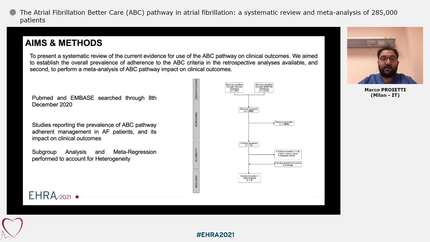
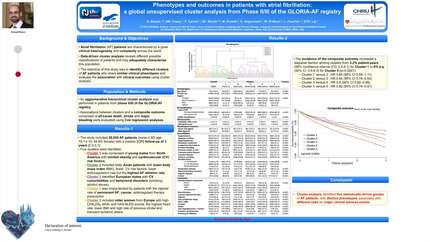
From the ChiOTEAF Registry, we performed a latent class analysis based on 16 cardiovascular (CV) and non-CV conditions. The association between classes of patients, management, and outcomes was evaluated. The primary outcome was a composite of all‐cause death and major adverse CV events. We assessed the impact of ABC adherence on outcomes in the whole cohort and among phenotypes. We included 4765 AF patients [median age 77 (68–83) years, 39.1% females]. Four phenotypes were identified: (i) low complexity (48.9%); (ii) atherosclerotic (19.3%); (iii) heart failure (19.4%); and (iv) high complexity (12.3%). During a 1-year follow-up, compared to the ‘low complexity’ class, the risk of adverse events was higher in ‘high complexity’ [aOR, 95% confidence interval (CI): 3.20, 2.21–4.66] and ‘heart failure’ classes (aOR, 95% CI: 1.50, 1.04–2.17). Among 2654 patients [median age 75 (66–81) years, 43.3% females] with available information to assess the ABC pathway, 1094 (41.2%) were adherent. ABC pathway adherence was associated with a lower risk of adverse events (aOR, 95% CI: 0.37, 0.20–0.65). On interaction analysis, its beneficial effect was similar across different clinical phenotypes (Pint = 0.122).
Different clinical phenotypes can be identified in Asian AF patients, with specific patterns of comorbidities and different risks of adverse events. Full ABC pathway adherence was associated with improved outcomes, regardless of the clinical phenotype.
Contributors

Marta Mantovani
Author

Jacopo F Imberti
Author
Steven H M Lam
Author
Agnieszka Babinska
Author


Gregory Y H Lip
Author
University of Liverpool Liverpool , United Kingdom of Great Britain & Northern Ireland
Gregory Y H Lip
Author
Xiaoying Li
Author
Yutang Wang
Author
Changsheng Ma
Author
Shu Zhang
Author
Congxin Huang
Author
Jiefu Yang
Author
Meilin Liu
Author
Yutao Guo
Author
Guangliang Shan
Author
Taixiang Wu
Author
Chen Yao
Author
Changsheng Ma
Author
Congchun Huang
Author
Cuntai Zhang
Author
Dang Aiming
Author
Dawei Qian
Author
Fakuan Tang
Author
Fang Wu
Author
Feng Liu
Author
Gexin Zhu
Author
Guo Yutao
Author
Guorong Xi
Author
Heng Dou
Author
Hou Cuihong
Author
Hua Li
Author
Hui Han
Author
Huiliang Liu
Author
Jian Kong
Author
Junxia Li
Author
Liang Zaoguang
Author
Liangyi Si
Author
Liu Meilin
Author
Liu Yanxia
Author
Liu Yu
Author
Liu Zhiming
Author
Luo Ma
Author
Ming Li
Author
Qian Xiao
Author
Qingwei Chen
Author
Qiong Chen
Author
Ren Xuejun
Author
Shan Zhaoliang
Author
Shi Xiangming
Author
Shilian Hu
Author
Song Bai
Author
Tianchang Li
Author
Wang Lijuan
Author
Wu Qiang
Author
Xianghu Wang
Author
Xiaojuan Bai
Author
Xiaoming Wang
Author
Xinchun Yang
Author
Xuan He
Author
Xuejun Liu
Author
Yan Li
Author
Yang Jiefu
Author
Yong Wang
Author
Yunmei Yang
Author
Zeng Yuan
Author
Zhang Shu
Author
Zhang Wei
Author
Zhanyi Lin
Author
You may be interested in