Quality of care and long-term survival after ST-elevation myocardial infarction in adults with cancer
European Heart Journal - Quality of Care and Clinical Outcomes


Abstract
While current evidence suggests that the clinical outcomes of ST-elevation myocardial infarction (STEMI) are worse among patients with cancer, it is unknown what role the quality of care received during admission plays. We aimed to evaluate the association between care quality and patient survival after discharge.
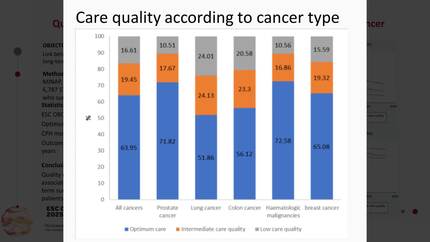
A nationally-linked cohort of STEMI patients (January 2005–March 2019) were obtained from the UK Myocardial Infarction National Audit Project and UK national Hospital Episode Statistics Admitted Patient Care registries. We used the composite opportunity-based quality indicator to measure overall care quality. Survival outcomes were assessed using Cox proportional hazard models and Kaplan–Meier and cumulative survival curves. In total, 6787 STEMI indexed admissions with cancer were identified. Of those, 4340 (63.9%) patients received optimum care, 1320 (19.5%) intermediate care, and 1127(25.2%) low care quality. Patients with low care quality were older [optimum quality median (IQR) = 72.8 (65.1, 79.6), intermediate quality 75.5 (67.9, 82.1), low quality 78.2 (69.2, 84.7)] and more frequently women (optimum quality 21.6%, intermediate quality 27.3%, low quality 35.5%). Compared to patients with optimum care, patients with low care quality had a higher risk of death at 30 days [hazard ratio (HR) 7.0, 95% confidence interval (CI) 5.7–8.7], 1 year (HR 4.0, 95% CI 3.6–4.4), and 5 years (HR 2.6, 95% CI 2.4–2.8). Relative survival analysis revealed that the number of patients who would survive nationally if they received optimal care is 84 (95% CI 67–102), 508 (95% CI 468–548), and 1096 (95% CI 1034–1158) at 30 days, 1 year, and 5 years, respectively. The association between care quality and survival was more profound in the Northwest and Northeast regions.
Quality of care is closely associated with short- and long-term survival among STEMI patients with cancer. Improving quality of care may save hundreds to thousands of lives in the shorter and longer term.
Contributors

Mohamed Dafaalla
Author
Muhammad Rashid
Author
Harindra C Wijeysundera
Author
Derek J Roberts
Author
Safi U Khan
Author
Ayman Elbadawi
Author

Phillip Freeman
Author
Christian Mallen
Author

You may be interested in