Effects of mavacamten on the cellular response to beta adrenergic and frequency dependent stress in an HFpEF mouse model
European Heart Journal


Abstract
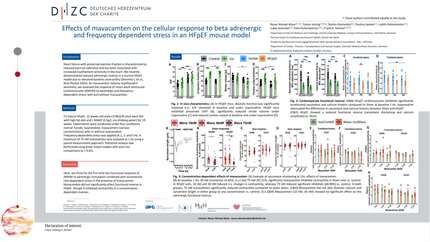
Heart failure with preserved ejection fraction is characterized by reduced exercise tolerance and has been associated with increased myofilament sensitivity in the heart. Our recent findings have shown that adrenergic functional reserve is diminished in a murine HFpEF model due to enhanced baseline contractility. Mavacamten, a myosin ATPase inhibitor, reduces myofilament sensitivity. In this study, we investigated the response of intact adult left ventricular cardiomyocytes (AMVM) to adrenergic and frequency-dependent stress, both with and without mavacamten, in a murine HFpEF model.
To induce HFpEF, 12 weeks old male C57BL6/N mice were fed with high-fat diet and L NAME (0.5g/l, via drinking water) for 19 weeks. Cellular calcium transients and sarcomere shortening were recorded. Experiments were performed under four conditions: normal Tyrode, +100 nM isoprenaline, mavacamten (+10 or +30 nM) with or without isoprenaline. Frequency-dependent stress was applied at 1Hz, 3Hz, and 5Hz. Maximal of 75 nM mavacamten was analysed at 1 Hz. Statistical analysis was performed using linear mixed models with post-hoc comparisons (p < 0.05).
HFpEF mice developed increased E/E', preserved LVEF and reduced exercise tolerance. HFpEF cardiomyocytes exhibited enhanced sarcomere shortening, calcium transient amplitude and significantly accelerated sarcomere and calcium kinetics compared to Sham at baseline 1 Hz. Isoprenaline attenuated the differences in sarcomere and calcium kinetics between Sham and HFpEF. With increasing pacing frequency, Sham cells showed a significant increase in sarcomere shortening amplitude, but not HFpEF. Similar results were found in the presence of isoprenaline. HFpEF showed a reduced functional reserve (sarcomere shortening and calcium amplitude) vs. Sham. At baseline 1 Hz, 30 nM (numerical 15.65%, n.s.) and 75 nM (55.21%, significant) mavacamten inhibited contractility in Sham cells vs. control. In HFpEF cells, 10 nM and 30 nM induced n.s. changes in contractility, whereas 75 nM induced significant inhibition (68.08%) vs. control. Mavacamten (10 nM, 30 nM) showed no significant effect on the adrenergic functional reserve (sarcomere shortening and calcium amplitude). Mavacamten (30 nM) did not alter the frequency response in sarcomere and calcium transient amplitude at 1 Hz, 3 Hz, or 5 Hz pacing in Sham and HFpEF cells, with or without isoprenaline. Mavacamten did not alter diastolic calcium and sarcomere length or calcium and sarcomere kinetics in either group at any concentration vs. control.
Here, we show for the first time the functional response of AMVM to adrenergic stimulation combined with incremental rate-dependent stress in the presence of mavacamten. Mavacamten did not significantly affect functional reserve in HFpEF, though it inhibited contractility in a concentration-dependent manner.
Contributors


T Jeising
Author
R Roshanbin
Author
P Sander
Author
J Huettemeister
Author
L Semmler
Author
F Hohendanner
Author
F Heinzel
Author
You may be interested in