Epicardial adipose tissue, functional status, and invasive exercise hemodynamics in heart failure with preserved ejection fraction: Insights from the REDUCE LAP-HF II trial
European Heart Journal


Abstract
Obesity is strongly associated with the development of heart failure (HF) with preserved ejection fraction (HFpEF). Beyond increased body mass index (BMI), an abundance of epicardial adipose tissue (EAT) may play a role in its pathophysiology.
To study the associations between increased EAT, functional status and invasive exercise hemodynamics in a large cohort of HFpEF patients.
This is a sub-analysis from a large randomized clinical trial that investigated an atrial shunt device in patients with HF with left ventricular ejection fraction ≥40% and exercise pulmonary capillary wedge pressure (PCWP) ≥25mmHg. At baseline, all patients underwent echocardiography, 6-minute walk distance (6-MWD) test, Kansas City Cardiomyopathy Questionnaire (KCCQ) and invasive hemodynamic assessment at rest and during supine ergometry. EAT thickness was measured on the free wall of the right ventricle on echocardiography, expressed in mm and patients were divided according to EAT tertiles.
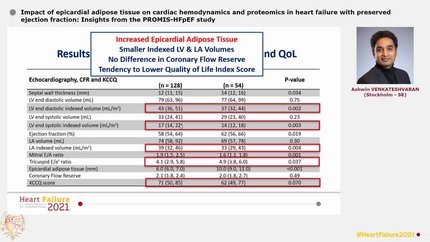
In total, 566 patients were examined. Their mean age was 72±8 years, 62% were women, mean BMI was 33±6 kg/m2 and mean EAT thickness was 6.0±2.4 mm, ranging from 1.7 to 17.2 mm. With increasing EAT thickness tertiles, 6-MWD and KCCQ overall summary score were significantly lower (320 vs. 315 vs. 287m, p=.01; 51 vs. 45 vs. 41, p=.003; respectively, Figure 1A-B). The association between increased EAT and lower KCCQ score was independent of BMI (p=.004, β: -2.6), whereas the association with lower 6-MWD was not independent of BMI (p=.1, β: -6.9). At rest, invasive hemodynamics were not different across EAT tertiles. At peak exercise, patients in the highest EAT thickness tertile had higher PCWP and PCWP to right atrial pressure gradient, as compared to patients in the first and second EAT thickness tertiles (36±8 vs. 34±8 mmHg, p=.009; 18±7 vs. 16±7 mmHg, p=.002, respectively, Figure 1C).
Excess EAT is common in patients with HFpEF and is associated with lower functional status and with higher left-sided filling pressures at peak exercise. These data suggest that EAT plays a significant role in functional status and exercise hemodynamics in HFpEF.
Contributors


S J Shah
Author
U Mylavarapu
Author
M O Hu
Author
J Komtebedde
Author
M Lobeek
Author
S E Litwin
Author
S D Solomon
Author
N Collins
Author
S Emani
Author
L Bruch
Author
D K Gupta
Author
B A Borlaug
Author

You may be interested in