Iron deficiency and anemia in heart failure with mildly reduced ejection fraction and their impact on prognosis and right ventricular-pulmonary artery coupling
European Heart Journal


Abstract
Iron Deficiency (ID), together with anemia, is a common condition in patients with heart failure (HF) and is observed across the full range of left ventricular ejection fraction (LVEF). Although ID has been suggested to be associated with myocardial mitochondrial dysfunction and reduced contractility, its relevance to cardiac function and hemodynamics has not been adequately studied in patients with HF with mildly reduced left ventricular ejection fraction (HFmrEF).
The aim of this study was to investigate the association of anemia and ID with prognosis and hemodynamics in patients with HFmrEF.
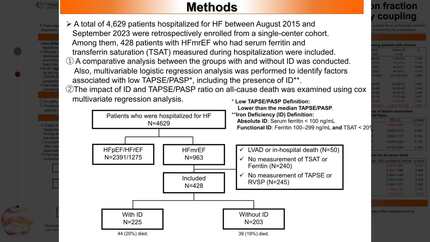
From the cohort study of 4,629 hospitalized HF patients (age 68+/-15, men 62%) between August 2015 and September 2023, this study enrolled 428 HFmrEF (i.e., left ventricular ejection fraction (LVEF) 41–49%) patients whose ferritin and transferrin saturation (TSAT) were measured during hospitalization. ID was defined as serum ferritin <100 ng/mL (absolute ID) or ferritin 100-299 ng/mL and TSAT <20% (functional ID). In this study, the prognostic impact of anemia was assessed, as well as the association between ID and right ventricular dysfunction using tricuspid annulus systolic shift (TAPSE) and the ratio between TAPSE and pulmonary artery systolic pressure (PASP) (TAPSE/PASP) as indicators of right ventricular-pulmonary artery coupling.
During median follow-up of 29 [13–41] months, 94 (22%) patients died. Anemia was present in 258 (60%) patients. Patients with anemia or ID had a significantly higher mortality than other patients (24% vs. 11%, log-rank p<0.05). There were 225 patients (53%) who met the definition of ID with a higher proportion in the anemic group than in the non-anemic group (59% vs. 43%, p<0.05). There were no significant differences in LVEF or brain natriuretic peptide levels between the ID and non-ID groups. The TAPSE/PASP ratio was significantly lower in ID group than non-ID group (0.45 vs. 0.48, p<0.05) (Table 1). Furthermore, when only the group of patients with anemia was examined, ID group had a significantly lower TAPSE/PASP ratio than non-ID patients (0.43mm/mmHg vs. 0.46mm/mmHg, P<0.05) (Table 2).
This study showed that patients with anemia or ID had a worse prognosis in HFmrEF patients. Furthermore, patients with ID showed reduced TAPSE/PASP, suggesting that ID may be related to the severity of HF and congestive state. These findings indicate that ID is not just a nutritional deficiency, but an important factor deeply involved in the pathogenesis of HFmrEF.
Contributors


M Ono
Author
A Mikami
Author
A Nokubo
Author
M Kishihara
Author
T Koike
Author
S Shirotani
Author
E Shibahashi
Author
Y Minami
Author
N Kikuchi
Author
H Hattori
Author
J Yamaguchi
Author
You may be interested in