FMO2 alleviates doxorubicin-induced cardiac injury via promoting XLF-dependent DNA repair
European Heart Journal


Abstract
To explore new molecular regulatory targets for doxorubicin (DOX)-induced cardiomyopathy (DIC) and provide novel therapeutic strategies for clinical treatment.
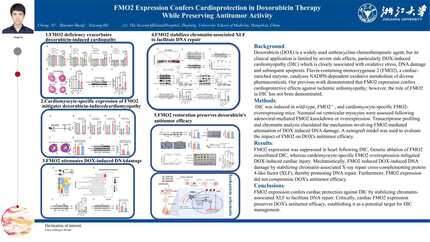
The clinical use of DOX is limited due to its severe cardiotoxicity, with DIC closely related to DNA damage and subsequent apoptosis. Flavin-containing monooxygenase 2 (FMO2), a drug-metabolizing enzyme, has been shown to play a crucial role in cardiac remodeling and various physiological and pathological processes. However, the role of FMO2 in DOX-induced cardiotoxicity remains insufficiently explored.
DIC models were established in wild-type, FMO2-/- and cardiomyocyte-specific FMO2-overexpressing mice to observe phenotypes. At the cellular level, adenoviral-mediated FMO2 knockdown/overexpression was performed to analyze the phenotype. The molecular mechanisms were studied by transcriptome sequencing, cytoplasmic-nuclear separation, and chromatin extraction to investigate the interaction of FMO2 with XLF and CDK1. Additionally, a xenograft model was used to evaluate the effect of FMO2 on DOX’s tumor-killing activity.
FMO2 is suppressed in DOX-induced cardiomyopathy. FMO2 ablation at genetic level exacerbates cardiac function in DIC, while cardiomyocyte-specific FMO2 overexpression alleviates DOX-induced cardiac injury. Mechanistically, FMO2 reduces DOX-induced DNA damage through XLF-dependent NHEJ regulation. FMO2 regulates CDK1 localization and in turn restoring XLF-mediated DNA repair. In addition, FMO2 overexpression does not affect DOX’s anticancer effect.
FMO2 modulates CDK1 subcellular localization, reduces its nuclear translocation to relieve its inhibition on XLF binding to chromatin, and promotes NHEJ repair, thereby alleviating cardiotoxicity, which providing a theoretical basis and effective target for future clinical applications.
Contributors


C H E N G Ni
Author
The Second Affiliated Hospital, Zhejiang University School of Medicine Hangzhou , China

W U X
Author
You may be interested in