Prognostic value of tricuspid regurgitation and right ventricular dysfunction after cardiac resynchronization therapy
European Heart Journal


Abstract
Tricuspid regurgitation (TR) and right ventricular dysfunction (RV dysfunction) are prevalent in heart failure patients and are strongly linked to adverse clinical outcomes.
This study aimed to evaluate the prognostic significance of post-cardiac resynchronization therapy (CRT) TR severity and RVdysfxn, as assessed by echocardiography, in patients undergoing CRT.
We prospectively followed 231 consecutive patients (mean age 68 ± 11 years, 180 men) who received CRT, with a median follow-up of 41 months. TR severity (graded 0–4: none, mild, moderate, moderate-severe, severe), RV dysfunction (defined as right ventricular fractional area change [RVFAC] < 35%), and left ventricular ejection fraction (LVEF) were evaluated via echocardiography before and within four weeks after CRT implantation. Pre- and post-procedural electrocardiograms were also obtained.
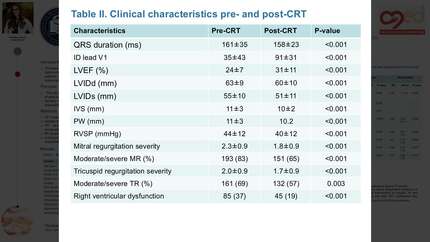
Baseline and immediate post-implant characteristics were as follows: LVEF increased from 24 ± 7% to 30 ± 11% (P value < 0.0001), and QRS duration decreased from 162 ± 35 ms to 158 ± 22 ms (P value = 0.285). Moderate or severe TR was observed in 159 patients (69%) pre-CRT and in 132 patients (57%) post-CRT (P value = 0.009). RV dysfunction was present in 85 patients (37%) pre-CRT compared with 45 patients (19%) post-CRT (P value <0.001). During follow-up, 143 patients (62%) did not survive. Kaplan-Meier survival curves demonstrated that both TR severity and RV dysfunction - particularly when assessed after CRT (see Figure) - were significant predictors of mortality. Although both pre- and post-CRT parameters were significant in univariate analysis, multivariate Cox regression identified post-implant TR severity and RV dysfunction as the strongest independent predictors of adverse outcomes, after adjusting for age, gender, baseline QRS duration, and LVEF, while the pre-CRT parameters did not maintain statistical significance.
Our findings highlight that moderate or severe TR and RV dysfunction following CRT are robust independent predictors of adverse outcomes. Targeted interventions to mitigate TR and optimize RV function during and after CRT implantation may significantly enhance patient survival and clinical outcomes.
Contributors


E D Blendea
Author
C A Eotvos
Author
R Lazar
Author
T Avram
Author
A Sarb
Author
I G Zehan
Author
P Schiop-Tentea
Author
G Coseriu
Author
G Gusetu
Author
S Pop
Author
D Mocan-Hognogi
Author
R Chiorescu
Author
E K Heist
Author

You may be interested in