Comparative efficacy and safety of lead-less pacemakers in patients requiring cardiac devices: meta-analysis
European Heart Journal


Abstract
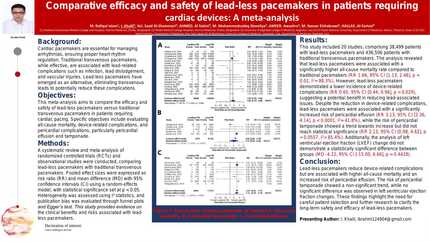
Cardiac pacemakers are essential for managing arrhythmias, ensuring proper heart rhythm regulation. Traditional transvenous pacemakers, while effective, are associated with lead-related complications such as infection, lead dislodgement, and vascular injuries. Lead-less pacemakers have emerged as an alternative, eliminating transvenous leads to potentially reduce these complications.
This meta-analysis aims to compare the efficacy and safety of lead-less pacemakers versus traditional transvenous pacemakers in patients requiring cardiac pacing. Specific objectives include evaluating all-cause mortality, device-related complications, and pericardial complications, particularly pericardial effusion and tamponade.
A systematic review and meta-analysis of randomized controlled trials (RCTs) and observational studies were conducted, comparing lead-less pacemakers with traditional transvenous pacemakers. Pooled effect sizes were expressed as risk ratio (RR) and mean difference (MD) with 95% confidence intervals (CI) using a random-effects model, with statistical significance set at p < 0.05. Heterogeneity was assessed using I² statistics, and publication bias was evaluated through funnel plots and Egger’s test. This study provides evidence on the clinical benefits and risks associated with lead-less pacemakers.
This study included 20 studies, comprising 38,499 patients with lead-less pacemakers and 436,506 patients with traditional transvenous pacemakers. The analysis revealed that lead-less pacemakers were associated with a significantly higher all-cause mortality rate compared to traditional pacemakers (RR 1.66, 95% CI [1.13, 2.46], p = 0.01). However, lead-less pacemakers demonstrated a lower incidence of device-related complications (RR 0.65, 95% CI [0.44, 0.96], p = 0.029), suggesting a potential benefit in reducing lead-associated issues. Despite the reduction in device-related complications, lead-less pacemakers were associated with a significantly increased risk of pericardial effusion (RR 3.13, 95% CI [2.36, 4.14], p < 0.0001), while the risk of pericardial tamponade showed a trend towards increase but did not reach statistical significance (RR 2.13, 95% CI [0.98, 4.62], p = 0.0557). Additionally, the analysis of left ventricular ejection fraction (LVEF) change did not demonstrate a statistically significant difference between groups (MD -4.22, 95% CI [-15.00, 6.66], p = 0.4428).
Lead-less pacemakers reduce device-related complications but are associated with higher all-cause mortality and an increased risk of pericardial effusion. The risk of pericardial tamponade showed a non-significant trend, while no significant difference was observed in left ventricular ejection fraction changes. These findings highlight the need for careful patient selection and further research to clarify the long-term safety and efficacy of lead-less pacemakers.
Contributors


A H M E D Al Sakini
Author
M Mohammedsadeq Shweliya
Author
A M E E R Awashra
Author
M Nasser Elshabrawi
Author
H A L L A S Al-Fartosi
Author
You may be interested in