Clinical impact of late phase responder in cardiac resynchronization therapy
European Heart Journal


Abstract
Cardiac resynchronization therapy (CRT) is an effective treatment for patients with heart failure and wide QRS. Although responder evaluation is commonly performed 6 months after CRT implantation in clinical setting, it has been reported that cardiac function may improve even after the evaluation1. The clinical impact of this late phase responder in CRT is unclear.
We evaluated the characteristics and prognosis of CRT late phase responder.
This is a single center retrospective study. Among consecutive 628 patients who underwent CRT implantation in our hospital from January 2012 to June 2024, 167 patients were included (excluding 461: CRT responders, loss of follow-up, loss of late follow-up cardiac function data, corrected transposition of great arteries, and patient with ventricular assist device). CRT responder was defined as an improvement of left ventricular ejection fraction (LVEF) >10% and/or reduced LV end-systolic volume (LVESV) >15% compared to baseline 6 months after CRT implantation, and CRT late phase responder was defined as a non-responder at 6months but became responders during follow-up period. We divided into CRT late phase responder and non-responder, and assessed the clinical outcomes between 2 groups.
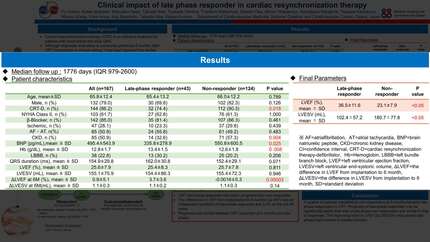
Of the 167 CRT non-responders, 43 patients (25.7%) became CRT late phase responders during a median follow-up of 1776 days (IQR 979-2600). The mean age was 65.8±12.4 years and 132 (79.0%) were male. CRT late phase responder group had a lower BNP levels and fewer patients with chronic kidney disease (335.8±278.9 vs 550.8±600.5 pg/mL: p=0.025, 32.6 vs 57.3 %:p=0.004, respectively). The difference in LVEF from CRT implantation to six-month follow-up (ΔLVEF) was higher in CRT late phase responder group (3.7±3.6 vs -0.0016±5.3 %:p=0.00003) and an independent predictor of CRT late phase responder by multivariate logistic analysis (OR 1.24, 95% CI 1.05-1.46; p=0.013), and ROC curve suggested 3.0% of ΔLVEF as the cut-off value (AUC 0.715, 95% CI 0.631-0.799). In terms of prognosis, both all-cause mortality and heart failure hospitalization were significantly lower in CRT late phase responders (log-rank p=0.001 and p=0.0002, respectively). As a subgroup analysis we compared all-cause mortality between CRT responder at 6 months and late phase, but there were not significant differences.
A quarter of patients classified as non-responders at 6 months became late phase responders in CRT. Prognosis of CRT late phase responder may be significantly better than that of CRT late phase non-responders and similar to that of CRT responder. The improving trend in LVEF after 6months after CRT implantation (ΔLVEF≥3%) may predict late phase improvement in cardiac function. Patient population Patient outcome
Contributors

K Ishibashi
Author
N Ueda
Author
T Ikee
Author
T Oshima
Author
T Nakamura
Author
S Oka
Author
A Wakamiya
Author
K Nakajima
Author
T Kamakura
Author
M Wada
Author
Y Inoue
Author
K Miyamoto
Author
T Aiba
Author
K Kusano
Author
You may be interested in