Implantable cardioverter-defibrillator therapy compared to amiodarone in Chagas cardiomyopathy: a systematic review and meta-analysis
European Heart Journal


Abstract
Sudden cardiac death (SCD), primarily due to ventricular fibrillation, is the leading cause of mortality in patients with Chagas cardiomyopathy (ChCM), accounting for over 10000 deaths annually. While implantable cardioverter-defibrillator (ICD) therapy is a well-established treatment for secondary prevention in patients with structural heart disease, its efficacy and safety in ChCM remain inconclusive and a subject of debate. We aim to provide enough evidence to support decision-making in this clinical scenario.
We conducted a systematic review and meta-analysis to compare the efficacy of ICD therapy, with or without amiodarone, versus amiodarone alone in patients with ChCM and documented ventricular tachycardia (VT). A comprehensive search of PubMed, Embase, Scopus, Cochrane, and LILACS databases was performed for studies published up to December 31, 2024. Pooled risk ratios (RRs) with 95% confidence intervals (CIs) were calculated to assess outcomes, which included all-cause mortality, SCD, and heart failure-related death.
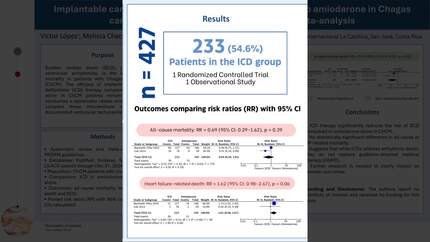
From 220 database search results, one RCT and one observational study involving 427 patients were included; 233 (54.57%) were in the ICD group. While all-cause mortality showed a downward trend in the ICD group (RR 0.69; 95% CI 0.29–1.62; p = 0.39; I² = 77%), this difference was not statistically significant. Similarly, heart failure-related death did not reach statistical significance (RR 1.62; 95% CI 0.98–2.67; p = 0.06; I² = 0%). However, a statistically significant reduction in the risk of SCD was observed in the ICD group (RR 0.16; 95% CI 0.03–0.73; p = 0.02; I² = 53%).
In patients with ChCM, ICD therapy significantly reduces the risk of SCD compared to amiodarone alone. However, this benefit does not appear to translate into reductions in all-cause mortality or heart failure-related mortality, underscoring the critical role of GDMT as the cornerstone of care. Further studies are needed to better evaluate its impact on broader clinical outcomes.


You may be interested in