Permanent pacemaker dependency after transcatheter aortic valve implantation: prevalence, patients characteristics and main determinants
European Heart Journal


Abstract
Permanent pacemaker implantation (PPI) remains a relevant complication following transcatheter aortic valve implantation (TAVI). The evolution of conduction disturbances, and long-term pacemaker dependency (PD) still represent a matter of investigation.
To study the prevalence, patients’ characteristics and predictors of PD after TAVI.
We analyzed consecutive patients who underwent TAVI (January 2022-November 2024) included in a prospectively maintained single-center database. Clinical, electrocardiographic (baseline, 24, 48 hours after TAVI, discharge), and procedural variables were systematically collected. Pacemaker interrogations were repeated at 1 and 12 months. PD was defined as the absence of intrinsic ventricular rhythm ≥30 bpm upon reducing the pacing rate to 30 bpm for at least 10" or following transient inhibition of pacing.
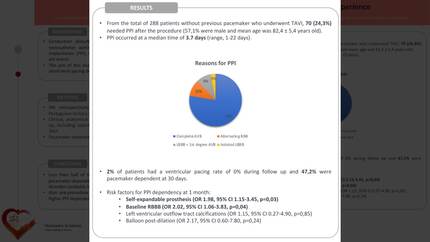
We included 376 patients (median age 82[78-84] years; 51% men). Sixty-nine (18.4%) underwent PPI after TAVI. There were no significant differences related to the use of self-expandable vs balloon-expandable valves. Pre-dilatation (OR[95%CI]:3.49[1.53-7.99], p=0.003), new-onset left bundle branch block (OR[95%CI]:5.54[2.43-12.63], p<0.001), and pre-existing right bundle branch block - RBBB (OR[95%CI]:20.68[7.10-60.23], p<0.001) were independent predictors of PPI at univariate and multivariate logistic regression analyses. Among patients undergoing PPI and surviving at 12 months follow-up (n=61), 23 (38%) were PD. They did not show significant differences in terms of clinical (except for a higher prevalence of chronic kidney disease - 39%vs16%, p=0.040), echocardiographic or procedural features compared to those not PD at follow-up. However, they showed significant ECG differences at baseline (i.e., longer QRS duration - 110 [90-140] msec vs 90 [80-100] msec, p=0.025; and RBBB - 12[52]% vs 8[21]%, p=0.012), and after the procedure (early-onset [i.e., 24h after TAVI] complete AV-block - 17[74]% vs 16[42]%, p=0.016). Median time interval between TAVI and PPI was significantly reduced in PD patients. (87[54-151] hours vs. 27[31-74] hours, p=0.0005). Chronic kidney disease (OR[95%CI]:3.42[1.02-11.48], p=0.046), baseline QRS duration (OR[95%CI]:1.03[1.00-1.06], p=0.015), pre-existing RBBB (OR[95%CI]:4.09[1.32-12.67], p=0.015), and new-onset complete AV block after TAVI (OR[95%CI]:4.09[1.32-12.67], p=0.015) were independent predictors of PD at univariate logistic regression analysis. At 12 months follow-up, spontaneous heart rate was lower (0[0-30] bpm vs. 65[50-70] bpm, p<0.0001), and median % of ventricular pacing was higher in PD patients (99[98-100]% vs 35[3-65]%, p<0.0001).
PPI is frequent after TAVI, with ~40% of these patients being PD at 12 months. Pre-existing AV and intraventricular conduction disturbances together with the early onset of a complete AV block after TAVI seem to be powerful predictors of the need for permanent pacemaker ventricular stimulation.
Contributors

G D Sanna
Author
P Merella
Author
G Talanas
Author
S Bandino
Author
G Serra
Author

V Micheluzzi
Author
Clinical and Interventional Cardiology, Sassari University Hospital Sassari , Italy
A Balata
Author
M Portoghese
Author
G Casu
Author
You may be interested in