The pacemaker shift during sinus rhythm depending on heart rate
European Heart Journal


Abstract
The earliest atrial site during sinus rhythm (EAS-SR) is often mapped before we perform catheter ablation of right atrium (RA) or supra vena cava (SVC), in order to prevent damage to sinoatrial node (SAN). On the other hand, an EAS-SR sometimes shifts depending on heart rate (HR). However, what HR affects it and how moves are not yet clarified.
We assessed 37 patients (70.90±11.26 years old, 24 males) who were referred for ablation of atrial arrhythmia and were performed for EAS-SR mapping using high density mapping catheter (HD grid catheter in 24 patients or Octaray in 13). After mapping EAS-SR at baseline, isoproterenol was infused and an EAS-SR was remapped with increased stable HR. We divided them into 2 groups; moving group was patients with the shift of EAS-SR more than 5mm between baseline and isoproterenol, and non-moving group was those without. Moving details and contributing factors for the EAS-SR shift were investigated. Patients with unstable sinus rhythm, pacemaker or past ablation around SAN were excluded.
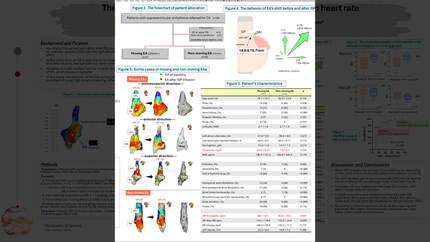
The HR elevated after isoproterenol in all patients(from 70.0±12.1 bpm to 110.7±15.5 bpm, p<0.0001), and 27 patients exhibited the shift of EAS-SR (moving group). The average migrated distance of EAS-SR was 14.6±15.7 mm and moving directions after isoproterenol were anterosuperior direction in 15, superior in 8, anterior in 3 and posterior in 1 (Figure 1). Moving group was related to lower HR and more inferior position of EAS-SR at baseline, compared to non-moving group (66.1±8.1 bpm vs. 80.0±15.3 bpm; p=0.0025, -10.75±12.09 mm vs. 0.15±7.28 mm from SVC-RA junction; p=0.0263). The receiver operating curve (ROC) analysis of basic HR showed the cut-off value of HR as 68.5 and 89 were good predictors for the EAS-SR shift (Figure 2, HR<68.5; sensitivity 73% and specificity 90%, HR>89; sensitivity 100% and specificity 30%, AUC= 0.8173, p=0.0036).
The EAS-SRs shifted anterior or superior direction in elevated HR, and which was notably correlated with lower basic HR, especially below 68. The EAS-SRs were unchanged in patients with basic HR over 89 bpm, even though HR after isoproterenol was increased.
Contributors

You may be interested in