Clinical outcomes after catheter ablation treatment of supraventricular tachycardias comparing non-irrigated solid tip, irrigated power controlled, and irrigated temperature-controlled catheters
European Heart Journal


Abstract
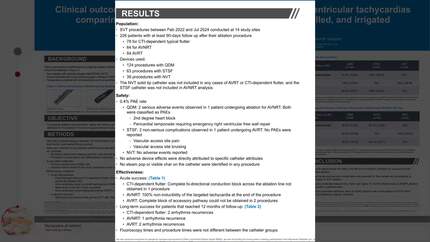
Various generations of radiofrequency mapping-enabled catheters (non-irrigated with solid tip [NVT], power-controlled with surround flow irrigation [STSF], temperature controlled with microelectrodes and surround flow irrigation [QDM]) have been developed for routine cardiac arrhythmia treatment. We used data from the prospective observational post-market, international SECURE study comparing ablation characteristics, safety and efficacy profiles of NVT, STSF, and QDM catheters for the ablation of common supraventricular tachycardias (SVTs).
Patients undergoing electrophysiology procedures using 3D electro-anatomical mapping and the multi-channel generator were recruited prospectively into SECURE and followed per usual clinical practice for up to 12 months. Data on complications and recurrence were recorded.
Data on 226 procedures with at least 90-days follow up, between Feb 2022 and Jul 2024 from 14 study sites was collected. This includes 78 ablations for typical flutter, 64 for atrioventricular nodal reentrant tachycardia (AVNRT), and 84 for atrioventricular reciprocating tachycardia (AVRT); 124 procedures performed with QDM, 63 with STSF, and 39 with NVT. The NVT solid tip catheter was not included in any cases of AVRT or CTI dependent flutter, and the STSF catheter was not included in AVNRT analysis.
Two serious adverse events were identified in 1 patient undergoing ablation for AVNRT with QDM (0.44% complication rate; 2nd degree heart block, pericardial tamponade requiring emergency right ventricular free wall repair). Two minor complications (groin bruising and pain) occurred in 1 patient undergoing AVRT ablation with STSF. No adverse device effects were directly attributed to specific catheter attributes. No steam pop or visible char on the catheter were identified in any procedure.
The acute success rates by arrhythmia were 100% for AVNRT, 97.5% for CTI-dependent flutter with QDM, 100% for CTI-dependent flutter with STSF, 94.6% for AVRT with QDM, and 100% for AVRT with STSF (Table 1). One patient with AVNRT, 2 patients with CTI-dependent flutter and 2 patients with AVRT had an arrhythmia recurrence within the follow-up period (Table 2). Fluoroscopy times and procedure times were not different between the catheter groups.
These results demonstrate the safety and efficacy of irrigated catheters for supraventricular tachycardia ablation. The overall acute success and complication rate of 0.44% reported for this dataset are comparable to published data on SVT ablation. Accepting the moderate dataset size, there was higher 12-month effectiveness in AVNRT ablation than observed in published data. Temperature-controlled catheters, such as QDM, perform well in the ablation of SVTs when compared to traditional solid-tip catheters. Acute success rates Long-term success
Contributors

L Leung
Author
St George's University Hospital NHS Foundation Trust London , United Kingdom of Great Britain & Northern Ireland
A Bajpai
Author
I Deisenhofer
Author
M Grimaldi
Author
K Nentwich
Author
G Szeplaki
Author
H Purerfellner
Author
M M Gallagher
Author
You may be interested in