Association between resting amygdala activity and appropriate defibrillator therapy in patients with organic heart disease
European Heart Journal


Abstract
The amygdala, a component of the limbic system, serves as the central control region of the autonomic nervous system. The sympathetic nervous system is known to be involved in ventricular arrhythmias. It has been reported that the activation of sympathetic nervous system by amygdala may be involved in the mechanism linking stress and risk for cardiovascular events. However, the association between amygdala activity and ventricular tachyarrhythmias is not yet clear.
To investigate the association between value of resting amygdala activity (AmygA) calculated by PET-CT and appropriate defibrillator therapy in ICD/CRT-D patients with organic heart disease.
We enrolled 40 consecutive patients with organic heart disease who underwent ICD/CRT-D implantation between 2003 and 2023 who had previously undergone 18F-fluorodeoxyglucose PET-CT. AmygA was derived by dividing the standardized uptake values (SUV) of amygdala by pons SUV. The primary endpoint was appropriate defibrillator therapy.
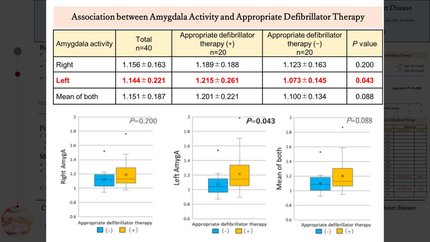
During a median follow-up of 2.8 (0.5-5.0) years, 20 (50%) patients received appropriate defibrillator therapy. Left AmygA values were significantly higher in patients with appropriate defibrillator therapy than in those without appropriate defibrillator therapy, while right AmygA were not (P = 0.043, 0.20, respectively). Therefore, patients were divided into high and low groups using the median value of left AmygA (1.084) as a cutoff. There were no significant differences in baseline characteristics including age, gender, underlying heart disease, cardiac function, and medications between the two groups. Kaplan-Meier analysis revealed significantly higher cumulative incidence of appropriate defibrillator therapy in the high left AmygA group (log-rank test, P=0.029). Multivariate analyses identified high left AmygA (HR 2.76, 95%CI 1.05-7.30, P=0.040) and past history of VT/VF (HR 2.52, 95%CI 1.01-6.25, P=0.047) as independent predictors of appropriate defibrillator therapy.
High left amygdala activity was associated with higher rates of appropriate defibrillator therapy in patients with organic heart disease. The incidence of appropriate therapy
Contributors


You may be interested in