Impact of long-term CPAP adherence on very late recurrence of atrial fibrillation after catheter ablation in non-overweight patients with severe obstructive sleep apnea
European Heart Journal


Abstract
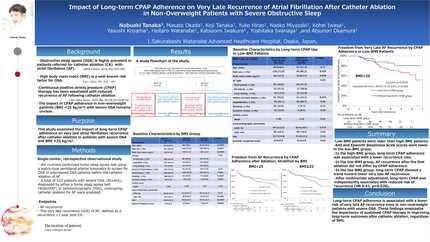
Obstructive sleep apnea (OSA) is a common comorbidity in patients with atrial fibrillation (AF), and high body mass index (BMI) is a well-known risk factor for OSA. While continuous positive airway pressure (CPAP) therapy has been associated with reduced recurrence of AF following catheter ablation, the impact of CPAP adherence in non-overweight patients (BMI <25 kg/m²) with severe OSA remains unclear.
This study aimed to investigate whether long-term CPAP adherence influences very late recurrence (VLR) of AF after catheter ablation in patients with severe OSA, specifically focusing on those with BMI <25 kg/m².
A total of 523 patients with severe OSA undergoing catheter ablation for AF were retrospectively analyzed. The cohort included 90 (17.2%) females, with a mean age of 65 ± 10 years and a mean BMI of 25.5 ± 3.6 kg/m². Of these, 242 patients (46.2%) had a BMI <25 kg/m². Patients were classified into two groups based on whether they maintained CPAP therapy for more than one year (long-term CPAP group). Recurrence rates were compared using Kaplan-Meier analysis, and multivariate Cox regression analysis was performed to assess the impact of CPAP adherence on VLR, adjusting for potential confounders.
In patients with BMI <25 kg/m², the AF recurrence rate after the first ablation did not significantly differ between those with and without long-term CPAP adherence (log-rank p=0.20). In contrast, in patients with BMI ≥25 kg/m², long-term CPAP adherence was associated with a significantly lower recurrence rate (log-rank p=0.037). When evaluating VLR, the BMI <25 kg/m² group showed a trend toward lower recurrence with long-term CPAP (log-rank p=0.052). However, after adjusting for age, sex, non-paroxysmal AF, left atrial diameter, and hypertension in a multivariate analysis, long-term CPAP adherence was independently associated with a reduced risk of VLR in the BMI <25 kg/m² group (hazard ratio [HR]=0.41, 95% confidence interval [CI] 0.16–0.91, p=0.028).
Long-term CPAP adherence is associated with a lower risk of very late AF recurrence even in non-overweight patients (BMI <25 kg/m²) with severe OSA. These findings emphasize the importance of sustained CPAP therapy in improving long-term outcomes after catheter ablation, regardless of BMI. KM curve according to CPAP ad in BMI<25
Contributors

You may be interested in