Improving outcomes of atrial fibrillation ablation through integrated personalized lifestyle interventions: preliminary results of a randomized controlled trial
European Heart Journal


Abstract
Atrial fibrillation (AF) is a lifestyle-related cardiac arrhythmia, with high rates of recurrence despite treatment with medication and ablation. Modifiable risk factors, such as obesity, obstructive sleep apnea (OSA) and alcohol consumption negatively affect AF treatment outcomes. While previous studies demonstrated benefits of single lifestyle interventions, such as weight loss or OSA treatment in selected patient populations, evidence from randomized controlled trials (RCTs) on the effects of an integrated AF lifestyle risk programs is limited. Additionally, no prior studies assessed risk modification in combination with state-of-the-art pulsed field ablation (PFA).
This RCT aims to determine whether participation in an integrated, nurse-led program AF, focused on personalized lifestyle interventions, OSA screening, and patient education, can improve PFA ablation outcomes in patients with symptomatic AF and at least one modifiable lifestyle risk factor. This trial seeks to strengthen the current limited evidence supporting personalized, integrated care in AF management.
We conducted an RCT involving patients referred for their first catheter ablation due to symptomatic paroxysmal or persistent AF.(1) Eligible participants had at least one of the following risk factors: body mass index (BMI) ≥27 kg/m², LDL-cholesterol >2.6 mmol/L or total cholesterol >5.0 mmol/L, hypertension, diabetes mellitus with HbA1c ≥53 mmol/mol, active smoking, or alcohol consumption >14 units/week. Participants were randomized 1:1 to either usual-care or a multidisciplinary integrated lifestyle intervention led by a specialized AF nurse. All patients underwent a multi-electrode PFA ablation and were followed for 12 months post-ablation. The primary endpoint was the rate of repeat ablations and hospital visits for cardioversion. Secondary outcomes included ablation success, defined as no recurrence of AF or use of anti-arrhythmic medication between 3-months and 12-months post-ablation.
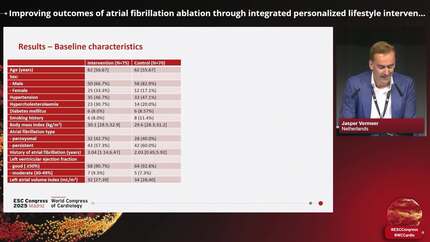
As of March 1, 2025, 119 patients had completed the 12-month follow-up. The median age was 62 years and 72% were male. Median BMI at baseline was 29.7 [28.3;31.6] kg/m² and 47% of patients had a history hypertension. AF was paroxysmal in 41% of patients and persistent in 59% of patients. For the primary endpoint in the intervention group, there were 268 events per 1000 patient-years. In the control group, there were 482 events per 1000 patient-years. Participants in the intervention group had less repeat ablations and hospital visits for cardioversion (RR 0.56, P=0.025). Additionally, patients in the intervention group demonstrated a trend towards higher ablation success, compared to the control group (73.8% versus 55.6%, P=0.058).
These preliminary findings suggest that a multidisciplinary, personalized lifestyle intervention program improves outcomes in patients undergoing PFA for AF. Full trial results are expected by May 2025. Graphical abstract Study outcomes
Contributors



You may be interested in