Fully digital enrollment in the NORwegian atrial fibrillation self-SCREENing trial (NORSCREEN)
European Heart Journal


Abstract
Atrial fibrillation (AF) is the most prevalent sustained arrythmia, with an increasing prevalence. Early detection and subsequent treatment of AF may reduce the risk of stroke.
The NORwegian atrial fibrillation self-SCREENing trial (NORSCREEN) is an ongoing randomized controlled trial (RCT) designed to evaluate whether self-screening for AF using a continuous patch ECG for seven days in individuals aged ≥65 years with at least one additional stroke risk factor, followed by initiation of guideline-recommended therapy in participants with detected AF, can reduce the stroke incidence.
Traditional recruitment methods for AF screening are challenging, resource-intensive and may impair research efficiency. Fully digital inclusion of study participants may provide a scalable and cost-effective alternative.
To evaluate the feasibility of a fully digital invitation and enrollment process in a large-scale AF screening trial.
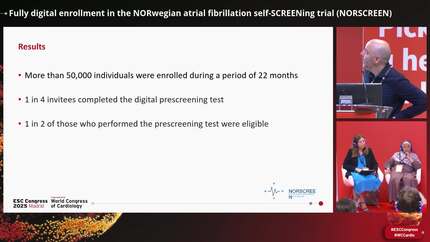
During the first 14 months of recruitment, 289,870 Norwegians aged ≥65 years were randomly identified from the National Population Register of Norway and invited to a digital self-service pre-screening process. A total of 88,341 (30.5%) of the invited individuals completed the pre-screening, and 45,786 (15.8%) of the invited individuals met all inclusion criteria while having no exclusion criteria (Figure 1). A total number of 30,244 individuals (10.4% of the invited) provided digital informed consent for study participation.
The mean age of the enrolled participants was 74,1 ±5,3 years and 46.7% were women. Participants were geographically well-distributed across all regions of Norway.
The NORSCREEN trial demonstrates the feasibility of fully digital recruitment and enrollment in a large-scale AF screening trial. One in three invited individuals completed the digital pre-screening process, and two in three eligible participants provided informed consent. These findings suggest that a fully digital approach can facilitate efficient, large-scale recruitment while reducing the logistical and resource burdens associated with traditional methods. Further analysis will determine the impact of this strategy on AF detection rates, treatment initiation, and ultimately, stroke prevention.
Contributors



You may be interested in