Therapeutic effect of selective serotonin reuptake inhibitors to gain-of-function KCND3 variant identified in a patient with early repolarization and refractory epilepsy
European Heart Journal


Abstract
Kv4.3 encoded by KCND3 is an α-subunit of the Ito channel and highly expressed in brain and heart. A gain-of-function (GOF) KCND3 variant, p.G306A, is a cause of early repolarization syndrome (ERS) and refractory epilepsy (RE), and it might be related with sudden unexpected death in epilepsy (SUDEP) which is an important cause of sudden death in patients with epilepsy. The variant increased the peak current and slowed the inactivation of Ito. Quinidine normalized GOF effect of the Ito with Kv4.3-G306A and prevented the symptoms of the patient with the variant. Thus, the suppression of increased Ito can be an effective treatment for ERS and RE. Fluoxetine, one of the selective serotonin reuptake inhibitors (SSRIs), was reported inhibiting Ito in concentration dependently. However, the effects of other SSRIs (paroxetine, sertraline, and fluvoxamine) to Ito and to increased Ito due to KCND3 variants remain unknown.
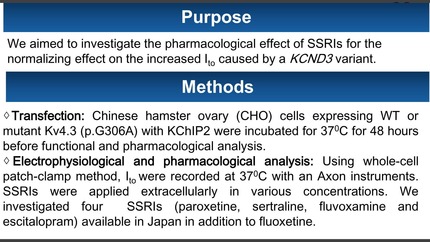
We aimed to investigate the pharmacological effect of SSRIs to Kv4.3-G306A.
Plasmids with Kv4.3 wild type (WT) or G306A were transiently transfected to Chinese Hamster Ovary cells, and Ito were recorded using whole-cell patch-clamp method at 37ºC degrees. SSRIs at 1-100 µM were applied externally, and the effects were analyzed.
The peak current density of G306A at +50 mV were significantly larger than that of WT and inhibited by SSRIs in concentration dependent manner (Figure A). Half-maximal inhibitory concentration (Figure B) and Hill coefficients were estimated, and values for G306A were 92.03±23 μM and 0.56±0.08 for sertraline, 27.21±9.74 μM and 0.78±0.23 for paroxetine, 38.77±9.74 μM and 0.95±0.19 for fluvoxamine and 70.36±14.3 μM and 0.51±0.05 for fluoxetine, respectively. Although the inactivation in G306A was significantly slower than that of WT, they were almost normalized by SSRIs (Figure A, C, D). Slowed inactivation by Kv4.3-G306A was accelerated by applications of 10 µM SSRIs, and inactivation time constants were similar to that of the WT baseline (Figure C and D). The inhibitory effects to mutant Ito by SSRIs were concentration dependent on both peak current densities and time constants. Significant leftward shift of activation curves of the mutant channel (half-maximal activation voltage (V1/2): -6.89±3.02 mV) were corrected by 10 µM of fluoxetine (V1/2: -0.4±2.55 mV), paroxetine (V1/2: 2.73±7.18 mV), and sertraline (V1/2: 3.52±5.49 mV) which were similar to that of the (V1/2: -0.35±3.33 mV). These functional findings were comparable to that of quinidine which we previously reported.
The GOF effect of Ito channel by a KCND3 variant was normalized by SSRIs. We report here that the SSRIs can be a therapeutic option to prevent sudden cardiac death of patients with GOF KCND3 variants.
Contributors


You may be interested in