The heritability of supraventricular tachycardia - a nationwide study in Danish twins
European Heart Journal


Abstract
Supraventricular tachycardia is a common type of arrythmia leading to patient distress and substantial healthcare utilization. While the mechanistic underpinnings of supraventricular tachycardia are well elucidated, the etiologies remain unknown.
This study aimed to determine whether and to what extent supraventricular tachycardia may be heritable using a classical biometrical twin study design.
Monozygotic and same-sex dizygotic twin pairs born in Denmark, where one or both members were diagnosed with supraventricular tachycardia between 1977 and 2024, were identified through the Danish Twin Registry and the Danish National Patient Registry. The outcome was defined as any in- or outpatient diagnosis of supraventricular tachycardia identified from ICD10 code I47.1. Twin pairs were defined with an index-twin and a co-twin; the "index-twin" was the twin first diagnosed with a supraventricular tachycardia, and the "co-twin" was the twin-sibling of the index-twin. The risk of supraventricular tachycardia according to zygosity was estimated using Cox proportional hazards regression models. Heritability of supraventricular tachycardia was assessed using probandwise concordance rates and biometrical models.
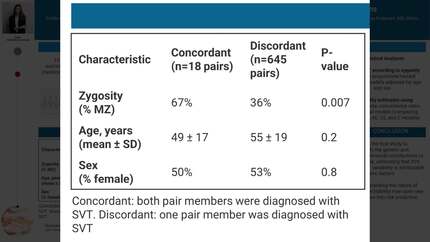
Of 32,324 twin pairs (12,006 monozygotic and 20,318 dizygotic pairs), at least one supraventricular tachycardia diagnosis was identified in 773 twin pairs. Of these, 18 pairs were concordant (both pair members developed the disease), and 755 pairs were discordant (only one pair member with the disease). After a supraventricular tachycardia diagnosis in the index-twin, the risk of supraventricular tachycardia was significantly higher in monozygotic co-twins compared to dizygotic co-twins (hazard ratio [HR] 3.6, 95% CI 1.32-9.63, p=0.01), which remained significant after adjusting for age (Figure). The probandwise concordance rate was markedly higher in monozygotic twins compared to dizygotic twins (16% vs. 5%, p<0.001). Biometrical models indicated that 35% of supraventricular tachycardia risk could be attributed to genetics and 65% to unique environmental components.
Based on a large nationwide population of monozygotic and same-sex dizygotic twins, this is the first evidence suggesting that supraventricular tachycardia is a heritable disorder. Addressing the genetic basis of this arrhythmia may foster the integration of family history into patient care and advance the field of personalized medicine for supraventricular tachycardia management.
Contributors


T Suvitaival
Author

G Gislason
Author
C Torp-Pedersen
Author
K Christensen
Author
T Biering-Soerensen
Author
G M Marcus
Author
You may be interested in