Feasibility of extravascular defibrillator implantation in a fully cardiological setting: from general anesthesia to deep sedation, and relevance of surgical back-up
European Heart Journal


Abstract
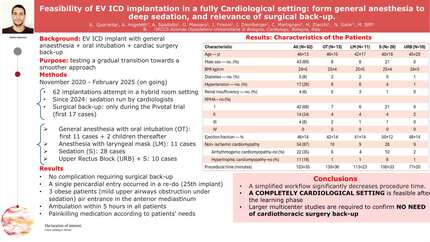
Since the PIVOTAL trial to the date, extravascular defibrillator (EV ICD) implant is most commonly carried out under general anaesthesia with oral intubation and cardiac surgery back-up, which limits its broad adoption in the majority of electrophysiology laboratories(1). In our centre we adopted a policy of gradual transition towards a smoother approach to this intervention, testing its safety and clinical impact on the workflow.
During the period from November 2020 to February 2025, 50 patients underwent EV ICD implantation attempt in a hybrid room setting, with only one shifting to a transvenous implant because of inadequate R wave amplitude. General anesthesia with oral intubation (OT) were used in the first 11 cases and in 2 children thereafter; anesthesia with laryngeal mask (LM) was used in 11 cases, sedation (S) without arterial monitoring has been used for the last 26 cases. Since 2024, the last 10 cases were done by sedation run by cardiologists. Surgical back-up terminated since the end of the Pivotal trial (after 17 cases).
No complication requiring surgical back-up occurred. A single pericardial entry occurred in a re-do procedure as the 25th procedure in the centre, and was discovered 2 weeks later. There were no complications in the three different groups of anesthesiologic management: no conversion to oral intubation or to ventilatory support in the deep sedation group occurred. In the deep sedation group a small amount of air entrance in the anterior mediastinum was observed in 3 obese patients owing to mild upper airways obstruction under sedation. This had no impact on the procedure. Implant duration was shorter under sedation compared to LM or OT procedures (Table 1). Ambulation was allowed within 5 hours from the procedure in all the 3 groups, painkilling medication being delivered according to patients' needs.
Transition to a procedure run in a cariological setting is feasible after an adequate learning phase. Larger multicenter studies are required to confirm its broad adoption in hospitals without cardiothoracic surgery back-up.
Contributors


C Martignani
Author
M Ziacchi
Author
A Angeletti
Author
G Massaro
Author
J Frisoni
Author
I Diemberger
Author
M Biffi
Author
You may be interested in