Ultrasound guided pectoralis nerve block compared to standard local anaesthesia in candidates to subcutaneous pacemaker: a single center experience
EP Europace Journal


Abstract
The number of patients undergoing cardiac implantable electronic devices implantation is increasing worldwide. The most diffuse approach to the management of pain control in this setting is local infiltration anaesthesia, but peri and post-procedural discomfort related to surgery still represents a significant concern especially considering the coexistence of comorbidities and fragility [1,2,3]
The aim of our study was to investigate the effectiveness of combined PECS I and PECS II block as a primary strategy for pain control in candidates to pacemaker implantation.
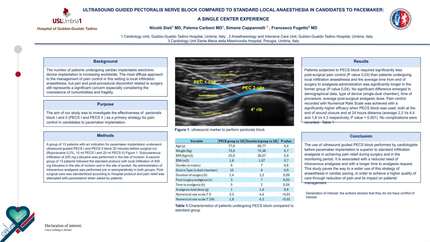
A group of 13 patients with an indication for pacemaker implantation underwent ultrasound guided PECS I and PECS II block 30 minutes before surgical cut (Ropivacaine 0,2%, 10 ml PECS I and 20 ml PECS II). Subcutaneous infiltration of 200 mg Lidocaine was performed in the site of incision. A second group of 13 patients followed the standard protocol with local infiltration of 400 mg lidocaine in the site of incision and in the site of pocket. No administration of intravenous analgesia was performed pre or perioperatively in both groups. Post surgical care was standardized according to Hospital protocol and pain relief was attempted with paracetamol when asked by patients.
Patients subjected to PECS block required significantly less post-surgical pain control (P value 0,03) than patients undergoing local infiltration anaesthesia and the average time from end of surgery to analgesia administration was significantly longer in the former group (P value 0,04). No significant difference emerged in demographical data, type of device (single-dual chamber), time of procedure, average post-surgical analgesic dose. Pain control recorded with Numerical Rate Scale was achieved with a significantly higher efficacy when PECS block was used, both at the end of wound closure and at 24 hours distance (average 2,3 Vs 4,4 and 1,8 Vs 4,3 respectively, P value < 0,001). No complications were recorded.
The use of ultrasound guided PECS block performed by cardiologists before pacemaker implantation is superior to standard infiltration analgesia in achieving pain relief during surgery and in the monitoring period. It is associated with a reduced need of intravenous analgesia and with a longer time to analgesia request. This study paves the way to a wider use of this strategy of anaesthesia in cardiac pacing, in order to achieve a higher quality of care through reduction of pain and its impact on patients management. Demographic, pre-postprocedural data Markers for PECS I and II block
Contributors

You may be interested in