Clinical impact of implantation impedance on pacing threshold increases during acute and chronic phases following Micra transcatheter pacing system implantation
European Heart Journal


Abstract
Achieving a favourable pacing threshold with the Micra™ Transcatheter Pacing System (Micra™ TPS) is essential to reduce battery depletion and prolong device longevity. The degree of contact between the leadless pacemaker and the myocardium can be estimated using impedance measurements. However, it remains unclear whether implantation impedance influences pacing threshold increases during both acute and chronic phases following Micra™ TPS implantation.
This study aimed to investigate whether the impedance at the time of Micra™ TPS implantation is associated with pacing threshold increases during both the acute and chronic phases.
We retrospectively analyzed 108 consecutive patients who received the Micra™ TPS. Successful implantation was defined as achieving a pacing threshold of ≤1.5V at 0.24 msec. An increase in pacing threshold was defined as exceeding 2.0V at 0.24 msec. Impedance was measured at implantation and during a two-year follow-up to evaluate its impact on pacing threshold stability.
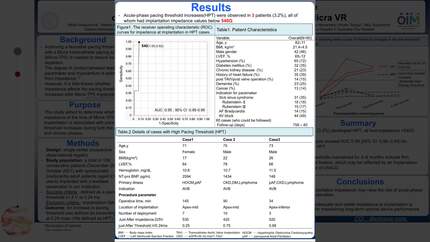
Micra TPS implantation was successful in all patients. The average impedance at implantation was 676 ± 135Ω. Acute-phase pacing threshold increases were observed in three patients (3.2%), all of whom had implantation impedance values below 540Ω. The Receiver Operating Characteristic curve - Area Under the Curve (ROC-AUC) was 0.95 (P=0.004), indicating a strong association between low implantation impedance and acute-phase threshold increases. No cases of newly elevated pacing thresholds were observed during the chronic phase, and patients with adequate and stable impedance at implantation maintained favourable pacing thresholds throughout the chronic phase.
Lower implantation impedance may increase the risk of acute-phase pacing threshold rises. However, achieving adequate and stable impedance at implantation ensured stable pacing thresholds in the chronic phase. These findings highlight the importance of appropriate impedance at implantation for long-term pacing stability and optimal device performance.


You may be interested in