Incidence and predictors of heart failure hospitalization in patients with the first marketed leadless pacemaker -micra VR
European Heart Journal


Abstract
Micra VR TPS, the first leadless pacemaker, offers a high effectiveness and lower complication rate than conventional transvenous pacemakers. It is especially suitable for patients with activities of daily living(ADL) decline. However, the risk of heart failure hospitalization after Micra VR implantation remains largely unexplored.
We investigated the incidence and predictors of heart failure hospitalization in patients who underwent de novo Micra VR implantations.
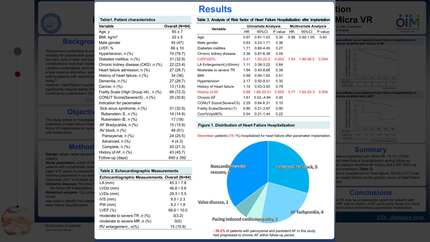
Ninety-four consecutive patients who underwent de novo Micra VR implantation (mean age 84.6±6.9 years, 45 males) were enrolled. During the mean follow-up period of 640±392 days, 17 (18.1%) patients were hospitalized due to heart failure post-implantations. Heart failure hospitalization was associated with a history of atrial fibrillation(AF) and reduced left ventricular ejection fraction (LVEF≤50%). Multivariate analysis revealed that a history of AF (hazard ratio [HR], 5.77; 95% confidence interval [CI], 1.64–20.3; P = 0.006) and reduced LVEF(LVEF≤50%) (HR, 7.04; 95% CI, 1.89–26.2; P = 0.004) were independent risk factors for heart failure hospitalization.
The presence of AF history and reduced LVEF were predictors of heart failure hospitalization in patients with Micra VR. Micra VR might become a reasonable device choice in patients who have normal LVEF and no history of AF especially in those with ADL decline. Graphical abstract
Contributors


You may be interested in