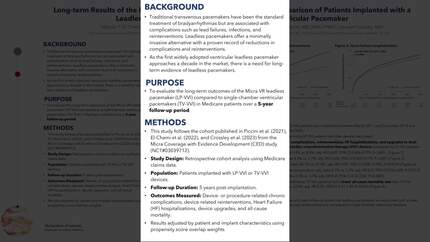
Long-term results of the Micra VR CED study: 5-year outcomes comparison of patients implanted with a leadless versus transvenous single-chamber ventricular pacemaker
European Heart Journal


Abstract
Current evidence shows lower complications and reinterventions from leadless pacemakers compared to traditional transvenous pacemakers. However, as the first widely adopted single-chamber ventricular leadless pacemakers (LP-VVI) approach a decade in the market, there is a need for long-term evidence of leadless pacemakers.
To compare complications, reinterventions, heart failure hospitalizations (HFH), and all-cause mortality at 5 years between LP-VVI and single-chamber ventricular transvenous pacemakers (TV-VVI).
This study follows the initial Micra CED Study cohort: Medicare fee-for-services patients implanted with LP-VVI or TV-VVI in 2017 and 2018 for 5 years after implantation. Medicare claims and enrollment data linked to manufacturer device registration information were used to identify de novo implants, patient characteristics, and pre-specified outcomes. Competing risk models adjusted for patient characteristics were used to compare outcomes between leadless and transvenous pacemaker patients.
6,219 LP-VVI and 10,212 TV-VVI patients were implanted during the study period. LP-VVI patients had significantly fewer complications and reinterventions compared to TV-VVI patients (complications: adj. rates 5.9% vs. 8.0%, adj. HR 0.69, 95% CI 0.61-0.78, P<0.001, Figure 1; reinterventions: adj. rates 4.9% vs. 7.7%, adj. HR 0.63, 95% CI 0.51-0.78, P<0.001, Figure 2). LP-VVI patients had significantly fewer HFH and upgrades to dual-chamber pacemakers or CRT devices than TV-VVI patients (HFH: adj. rates 24.7% vs. 27.0%, adj. HR 0.90 95% CI 0.84-0.97, P=0.004; upgrades to dual-chamber pacemakers: adj. rates 0.3% vs. 1.0%, adj. HR 0.65 95% CI 0.52-0.82, P=0.013; upgrades to CRT: adj. rates 2.1% vs. 3.1%, adj. HR 0.65 95% CI 0.52-0.82, P<0.001). At 5 years, 114 (4.1%) of surviving LP-VVI patients had their device inactivated. Adjusting for patient characteristics, LP-VVI patients had a lower all-cause mortality rate than TV-VVI patients (adj. rate 60.2% vs. 62.0%, adj. HR 0.95, 95% CI 0.91-1.00, P=0.042; unadj. HR 1.10, 95% CI 1.04-1.17, P=0.002).
The comparison of outcomes at a 5-year follow-up in a Medicare population shows that leadless pacemakers are associated with a lower rate of chronic complications and reinterventions as compared to single-chamber ventricular leadless pacemakers.
Contributors



You may be interested in