Cardiac arrest in the rest-room environment: not uncommon and with adverse resuscitation profile
European Heart Journal


Abstract
Out-of-hospital cardiac arrest (OHCA) on the toilet has been reported to be common and possibly driven by straining or vagal stimulus. Toilet-associated OHCA may also create a challenging resuscitation environment.
The national Danish sudden death registry and state-wide Australian End Unexplained Cardiac Death (EndUCD) registry were examined. Persons with a fatal OHCA aged 5-50 years with autopsy-confirmed cardiac or unascertained aetiology were included. Resuscitation-related, aetiological and forensic factors were compared between persons experiencing fatal OHCA on-toilet versus elsewhere. A composite variable of physiological conditions creating pressure-load or pressure-sensitivity was created, comprising hypertrophic cardiomyopathy, aortic stenosis/coarctation, and aortic aneurysm/dissection.
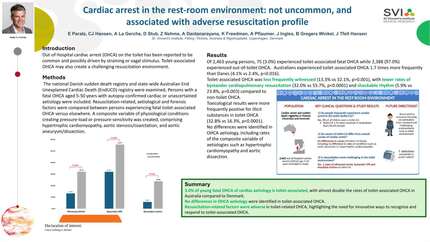
Of 2,463 persons, 75 (3.0%) experienced on-toilet cardiac arrest while 2,388 (97.0%) experienced out-of-toilet OHCA. Australians experienced on-toilet OHCA 1.7 times more frequently than Danes (4.1% vs 2.4%, p=0.016). Toilet-associated OHCA was less frequently witnessed (13.3% vs 32.1%, p=0.001), with lower rates of bystander cardiopulmonary resuscitation (32.0% vs 55.7%, p<0.0001) and shockable rhythm (5.9% vs 23.8%, p=0.003). Toxicological results were more frequently positive for illicit substances in toilet-related OHCA (32.8% vs 16.3%, p<0.0001). No differences were found in OHCA aetiology including in rates of the composite variable of hypertrophic cardiomyopathy, aortic stenosis/coarctation, and aortic aneurysm/dissection.
3.0% of young OHCA occurs on-toilet, with almost double the rates of toilet-related OHCA in Australia compared to Denmark. No differences in OHCA aetiology were identified in toilet-related OHCA. Resuscitation-related factors were universally adverse in toilet-related OHCA, highlighting the need for innovative ways to recognise and respond to toilet-associated OHCA.
Contributors




You may be interested in