Electrocardiogram abnormalities increase 5-year risk of out-of-hospital cardiac arrest in elderly patients
European Heart Journal


Abstract
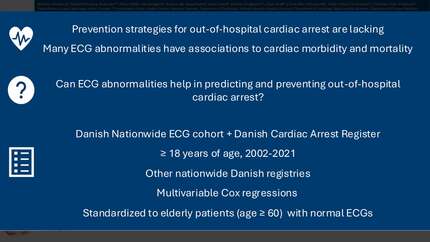
Many common electrocardiogram (ECG) abnormalities have previously been associated with increased risks of cardiac morbidity and mortality.1–3 However, knowledge of risk profiles in terms of out-of-hospital cardiac arrest (OHCA) for specific ECG abnormalities is still scarce.
To investigate the 5-year risk of OHCA for various ECG abnormalities.
Patients having an ECG recorded in a hospital or ambulance from January 1st 2000 to December 31st 2021 were included in the study. Further data on these patients were collected from other registries, including information on OHCA. Patients were followed until either OHCA, emigration, death from other causes or end of study period, whichever came first. For every patient, only the first recorded ECG were considered for analysis, along with the first OHCA event. All ECGs were analyzed using version 243 of the Marquette 12SL algorithm (GE Healthcare, Milwaukee, WI, USA). Estimates of 5-year risk of OHCA were obtained by first performing a multivariable Cox proportional hazards regression model assessing the whole cohort while adjusting for patient age, sex, comorbidity and drug use, upon which the model was combined with a corresponding one for death from other causes and standardized to patients aged 60 years and above.
For this study, 2,135,464 patients were included. Of these, 26,782 (1.25%) patients had OHCA during follow-up. A total of 1,056,744 patients were aged 60 years or above. Median follow-up time for the whole cohort was 5.27 years. Patient characteristics for the entire cohort and elderly patient group are shown in Table 1. Patients with OHCA were generally older and more likely to be male, have more ECG abnormalities and comorbidities as well as drug use (all P<0.01). Only congenital heart disease was not more frequent in patients with OHCA (P=0.85). The same was the case for patients aged 60 years and above, although malignancy was not more frequent for patients with OHCA in this patient category (P=0.89).
Results of 5-year OHCA risk estimation are shown in Figure 1. Atrial fibrillation, left posterior fascicular block, bifascicular block, right and left bundle branch block, Q-wave, ST-depression and -elevation, QTc prolongation and left ventricular hypertrophy had a significantly higher 5-year risk of OHCA for patients aged 60 years and above. The highest 5-year risks of OHCA were seen for left posterior fascicular block (1.56%, [95% CI: 1.22%-1.90%]), left bundle branch block (1.43%, [95% CI: 1.34%-1.52%]) and ST-depression (1.41%, [95% CI: 1.34%-1.47%]). For the remaining ECG abnormalities, no significant associations were observed.
In patients aged 60 years and above, we found 9 different ECG abnormalities that increase the 5-year risk of OHCA. The highest risk was observed for left posterior fascicular block, left bundle branch block, and ST-depression.
Contributors


You may be interested in