Development and validation of the RISE-APOCALYPSE-VT risk score for predicting ventricular tachycardia/fibrillation in AMI
European Heart Journal


Abstract
The objective of this study was to develop and validate a predictive model for the occurrence of ventricular tachycardia (VT) and/or fibrillation (VF) in patients admitted to a coronary care unit (CCU) with acute myocardial infarction (AMI).
We included 15,163 patients with AMI from 2005–2024. Patients were classified as STEMI or NSTEMI, with VT/VF confirmed by ECG/telemetry. The dataset was randomly split into a derivation (70%) and validation cohort (30%). Statistical analysis included logistic regression with penalized B-splines to address non-linearity and a Classification and Regression Tree algorithm for optimal cut-offs. Backward stepwise elimination was used for multivariate modeling, with collinearity assessed via VIF and correlation matrices. Missing data were handled using SPSS surrogate splits. Model validation included 1000 bootstrap, AUC-ROC, Hosmer-Lemeshow, and Brier score.
10,651 derivation and 4,512 validation cohort patients, VT/VF incidence was 7.2% and 6.6%, respectively. VT/VF patients were older, had more STEMI, dyspnea, syncope, heart failure, lower BP, and higher HR (p<0.001). They required more mechanical ventilation, vasopressors; also, a higher presentation with CSWG-SCAI score higher in the VT/VF patients in both cohorts (P<0.001).And higher mortality (44.8% vs. 5.2%, P<0.001). (Table 1)
A multivariable logistic regression model identified independent VT/VF predictors after VIF correction and variable selection, leading to the RISE-APOCALYPSE-VT score:
Risk factors: STEMI (OR 1.32), Killip-Kimball> II (OR 1.36), neurological alterations (OR 2.33), PVC (OR 2.72) mechanical ventilation (OR 3.04), transitory pacemaker (OR 2.22) and SCAI stage > B (OR>1.75)
Protective factors: T-wave inversion (OR 0.77) and AV block (OR 0.57)
Stratified risk factors: Heart rate, LVEF, eGFR by CKD-EPI, K+, Mg++ and lactate levels.
These findings were used to develop a VT/VF risk score. (Figure 1)
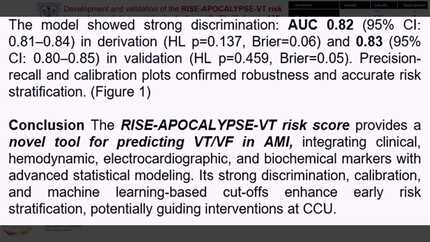
The ROC curves showed an AUC of 0.82 (95% CI: 0.81–0.84) in the derivation cohort plus HL P=0.137 and Brier score 0.06; and 0.83 (95% CI: 0.80–0.85) in the validation cohort plus HL P=0.459 and a Brier score 0.05, indicating high predictive accuracy. The precision-recall curves confirmed stable performance. Calibration plots showed that the observed and predicted probabilities aligned well, with progressive increases in VT/VF risk as total score increased. (Figure 1)
The RISE-APOCALYPSE-VT risk score provides a novel tool for predicting VT/VF in AMI, integrating clinical, hemodynamic, electrocardiographic, and biochemical markers with advanced statistical modeling. Its strong discrimination, calibration, and machine learning-based cut-offs enhance early risk stratification, potentially guiding interventions at CCU. Demographical characteristics Score card, ROC & Calibration
Contributors

J A Ortega-Hernandez
Author
Instituto Nacional de Cardiologia Ignacio Chavez Ciudad de Mexico , Mexico

H Gonzalez-Pacheco
Author
S Nava-Townsend
Author
K A Fierros-Chable
Author
D Manzur-Sandoval
Author
R Gopar-Nieto
Author
J Hernandez-Montfort
Author
A Arias-Mendoza
Author
You may be interested in