The perfect storm: reflex vasodepression with blunted heart rate response in stretch-induced syncope
European Heart Journal


Abstract
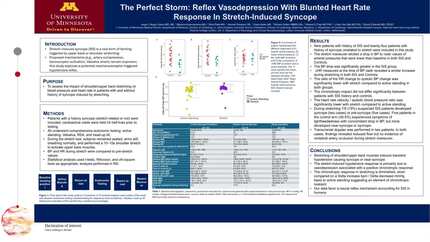
Stretch-induced syncope (SIS) is a rare form of situational reflex syncope triggered by shoulder/upper back stretching. In this regard, while activation of large lower extremity muscle groups has been shown to alter heart rate (HR) and blood pressure (BP), the impact of shoulder/upper back stretching on cardiovascular parameters has not been systematically investigated.
To evaluate the nature of BP and HR changes during shoulder/upper back stretching in SIS patients and healthy control subjects and compare findings to HR and BP changes during active standing (AS).
The study cohort comprised 33 subjects (83.3% female, median age 33 years, range 22-45) undergoing autonomic evaluation. Continuous beat-to-beat HR and BP were monitored during a standardized shoulder/upper back stretch maneuver lasting 10-15 seconds and an active standing (AS) test. Changes in systolic BP (SBP), mean arterial pressure (MAP), HR, and HR change normalized per mmHg BP drop (absolute value, ∆HR/∆SBP ratio) were compared during stretch and AS.
Both SIS (n=9) and Controls (n=24) dropped BP with the stretch maneuver, but SIS patients exhibited more pronounced BP reduction (∆SBP: -46.5 vs -28.5 mmHg, p=0.003; ∆MAP: -31.5 vs -18.7 mmHg, p=0.013). However, despite greater stretch-induced hypotension, compensatory HR increases did not differ between groups (SIS: +11.5 bpm, Controls: +9.5 bpm, p=NS). The normalized HR increment associated with BP drop (∆HR/∆BP ratio) was less with stretch than with AS (0.29 vs 1.1 bpm/mmHg, p<0.001) indicating that chronotropic compensation was reduced with stretch-induced BP drop. Moreover, ∆HR/∆BP also tended to be less pronounced in SIS patients compared to controls during both stretching (0.3 vs 0.7) and AS (0.8 vs 1.74), although apparent differences did not reach statistical significance (p=0.27 and p=0.18, respectively), likely due to limited sample size (Figure 1). In summary, BP drop triggered by stretch is associated with an impaired chronotropic response compared to similar BP drop with AS.
Our findings reveal that stretch-induced hypotension in SIS patients is characterized primarily by a vasodepressor hypotensive response with a less than expected chronotropic response for degree of stretch-induced hypotension. The attenuated HR response suggests that a cardioinhibitory neural reflex mechanism contributes to SIS pathophysiology.
Contributors

You may be interested in