Impaired heart rate response in pure autonomic failure: diminished baroreflex compensation during initial orthostatic hypotension
European Heart Journal


Abstract
A transient drop of blood pressure (BP) shortly after moving from seated or supine position to standing is a physiologic occurrence that most often goes unnoticed. However, near-syncope or falls may occur if the BP drop is sufficiently severe (usually considered a systolic BP drop ≥40mmHg) in which case it is termed 'initial' or 'immediate' orthostatic hypotension (iOH). In health, the BP drop in iOH is accompanied by an increased heart rate (HR) that contributes to hemodynamic recovery. However, while in patients with major autonomic disturbances such as those with Pure Autonomic Failure (PAF) a limited chronotropic compensation may be expected to aggravate iOH severity, the impact of a diminished HR response has yet to be systematically studied.
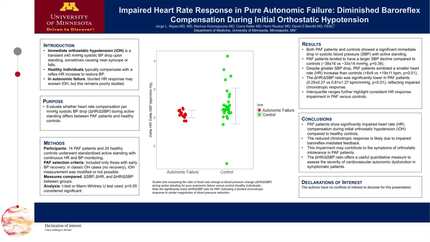
To evaluate the relationship between magnitude of BP drop and compensatory HR changes during active standing in PAF patients compared to healthy controls, expressed as the normalized HR response per mmHg of systolic BP drop (ΔHR/ΔSBP).
The study cohort comprised PAF patients (n=14) and healthy controls (n=24) undergoing autonomic evaluation. Continuous beat-to-beat HR and BP were monitored during a standardized active standing test. Changes in systolic BP (SBP), heart rate (HR), and the ratio of HR change normalized per mmHg BP drop (ΔHR/ΔSBP) were compared between groups. Statistical analysis was performed using t-test for normally distributed data and Mann-Whitney U test for non-normally distributed data, with p<0.05 considered statistically significant.
Both PAF patients and controls exhibited significant immediate BP drop from baseline values with active standing, with PAF patients tending to show a more pronounced decline in SBP compared to controls (ΔSBP: -38±16 vs -33±14 mmHg, p=0.38). However, despite the greater SBP fall, PAF patients had a lesser HR response (ΔHR: +8±9 vs +19±11 bpm, p=0.01) compared to controls. Consequently, the ΔHR/ΔSBP ratio was significantly lower in PAF patients (PAF: 0.25±0.27 vs. Controls: 0.81±1.27 bpm/mmHg, p=0.01) (Figure). The interquartile range was also markedly different between PAF patients (0.14, 0.25) and controls (0.33, 0.58), indicating a consistently impaired chronotropic response in PAF.
Our findings reveal that PAF patients exhibit significantly impaired HR compensation in iOH relative to the magnitude of orthostatic BP drop when compared to healthy controls. This diminished chronotropic response may be due to impaired baroreflex-mediated feedback and likely contributes to the symptom burden associated with orthostatic intolerance in PAF. Further, the ΔHR/ΔSBP ratio provides a quantitative assessment that may be a useful additional tool to assess severity of cardiovascular autonomic disturbance in a range of symptomatic patients.
Contributors

You may be interested in