Significance of peri-device leak detected by cardiac CT after percutaneous left atrial appendage occlusion
European Heart Journal


Abstract
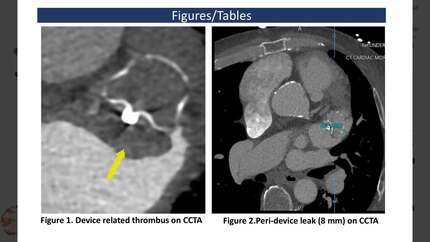
Cardiac computed tomography with angiography (CCTA) has evolved as a sensitive non-invasive tool for the assessment of implanted left atrial appendage occluding (LAAO) device during post-procedural follow-up. The significance of peri-device leak (PDL) detected by CCTA is not well determined.
We aim to determine the association of PDL (of any size) as detected by CCTA with major thromboembolic events post percutaneous LAAO (p-LAAO).
This was a retrospective observational study of patients who underwent p-LAAO using single lobe Watchman devices (1st and 2nd generation) at Allina system hospitals between 2016-2023. We included patients who had CCTA for the assessment of the occluding device post implantation. Our primary endpoint was a composite of stroke or TIA or systemic embolism during follow up.
We included 100 patients to our analysis, half of them (51%) were females with a median age of 77 (72, 84) years at the time of p-LAAO. Patients had a median CHA2DS2VASC score of 4 (3, 5), and HASBLED score of 3 (2,4). Most (90%) of the patients were prescribed either DOAC or warfarin for 45 days post implantation. CCTA done at a median timing of 57 (48, 340) days post implantation, demonstrated PDL in 22 (22%) patients with a median size of 4 mm (2, 5). Meanwhile, DRT was found in 4 (4%) patients. During a median follow up duration of 2.25 (1.4, 3.5) years, 9 (9%) patients suffered the primary endpoint. Comparing patients with well seated device to those with detected PDL on CCTA, the two groups were similar regarding the post procedural anticoagulation regimen (Well-seated; 71 (91%) vs PDL; 19 (86%), p=0.8). There was no significant difference in the incidence of primary endpoint between the two groups (Well-seated; 7 (9%) vs PDL; 2 (9.1%),p>0.9). Two (9%) patients in the PDL group had there OAC duration extended due to PDL on CT. There was a significant association between PDL and DRT incidence on CCTA (Well-seated; 1 (1.3%) vs PDL; 3 (14%), p=0.046).
PDL as detected by CCTA is common (22%) after p-LAAO with Watchman device. PDL (of any size) was not significantly associated with the occurrence of thromboembolic events post p-LAAO in our patient population. Meanwhile, PDL was associated with higher DRT incidence during follow up.
Next steps
Better definition and measurement criteria are needed for the detection of clinically relevant PDL on CCTA.
Contributors

M Katsiyiannis
Author
M Kapphahn-Bergs
Author
S Casey
Author

M Desouki
Author

J Sengupta
Author
Minneapolis Heart Institute and Abbott Northwestern Hospital Minneapolis , United States of America
You may be interested in