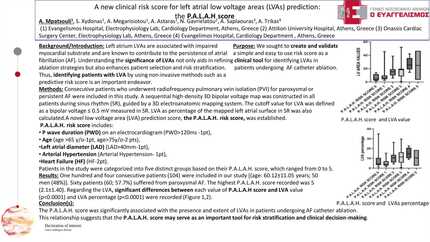
A new clinical risk score for left atrial low voltage areas (LVAs) prediction: the P.A.L.A.H score
European Heart Journal


Abstract
Left atrium LVAs are associated with impaired myocardial substrate and are known to contribute to the persistence of atrial fibrillation (AF). Understanding the significance of LVAs not only aids in refining ablation strategies but also enhances patient selection and risk stratification.
Thus, identifying patients with LVA by using non-invasive methods such as a predictive risk score is an important endeavor.
We sought to create and validate a simple and easy to use risk score as a clinical tool for identifying LVAs in patients undergoing AF catheter ablation.
Consecutive patients who underwent radiofrequency pulmonary vein isolation (PVI) for paroxysmal or persistent AF were included in this study. A sequential high-density 3D bipolar voltage map was constructed in all patients during sinus rhythm (SR), guided by a 3D electroanatomic mapping system. The cutoff value for LVA was defined as a bipolar voltage ≤ 0.5 mV measured in SR. LVA as percentage of the mapped left atrial surface in SR was also calculated.
A novel low voltage area (LVA) prediction score, the P.A.L.A.H. risk score, was established. It includes P wave duration (PWD) on an electrocardiogram (PWD>120ms -1pt), Age (age >65 y/o-1pt, age>75y/o-2 pts), Left atrial diameter (LAD) (LAD>40mm-1pt), Arterial Hypertension (Arterial Hypertension- 1pt), Heart Failure (HF) (HF-2pt). Patients in the study were categorized into five distinct groups based on their P.A.L.A.H. score, which ranged from 0 to 5.
One hundred and four consecutive patients (104) were included in our study [(age: 60.12±11.05 years; 50 men (48%)]. Sixty patients (60; 57.7%) suffered from paroxysmal AF. The highest P.A.L.A.H. score recorded was 5 (2.1±1.40). Regarding the LVA, significant differences between each value of P.A.L.A.H score and LVA value (p<0.0001) and LVA percentage (p<0.0001) were recorded (Figure 1,2).
The P.A.L.A.H. score was significantly associated with the presence and extent of LVAs in patients undergoing AF catheter ablation. This relationship suggests that the P.A.L.A.H. score may serve as an important tool for risk stratification and clinical decision-making. P.A.L.A.H. score and LVAs percentage P.A.L.A.H. score and LVA value
Contributors



You may be interested in