Pulsed-field versus cryoballoon versus radiofrequency ablation in young patients with atrial fibrillation undergoing pulmonary vein isolation
European Heart Journal


Abstract
Pulmonary vein isolation (PVI) is a well-established treatment for atrial fibrillation (AF), with cryoballoon ablation (Cryo), pulsed field ablation (PFA), and radiofrequency ablation (RFA) as the primary energy sources. However, little is known about the effectiveness of the three ablation modalities in young patients with AF.
This study aimed to compare the procedural characteristics, safety, and effectiveness of PFA, Cryo, and RFA in patients ≤ 50 years of age undergoing PVI.
Patients aged ≤ 50 years with AF undergoing their first PVI were consecutively enrolled at two tertiary referral centres and followed for 1 year after the procedure. Patients were divided into three groups according to the energy source used for PVI: Cryo, PFA, and RFA.
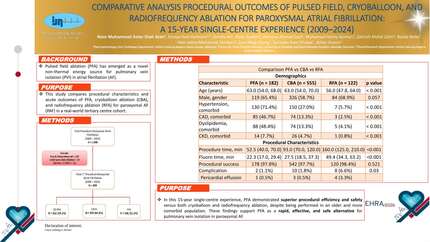
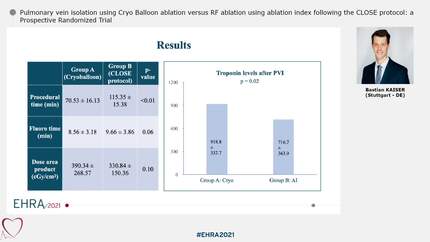
A total of 355 patients (median age 46 [41-49] years, 18% female) were included, of whom 95 patients (27%) underwent Cryo, 102 patients (29%) PFA, and 158 patients (44%) RFA. The median procedure duration was 63 [51 – 81] min for Cryo, 67 [47 – 101] min for PFA, and 94 [75 – 130] min for RFA (p < 0.001). Similarly, left atrial dwell time was 44 [34 – 57] min for Cryo, 43 [27 – 74] min for PFA, and 76 [57 – 97] min for RFA (p < 0.001). Fluoroscopy time was significantly shorter in the RFA group (5 [3 – 8] min), compared to Cryo (14 [11 – 20] min) and PFA (15 [10 – 25] min, p < 0.001). Overall, three complications (0.8%) occurred: one phrenic nerve injury in the Cryo group (1.1%) and two pericardial tamponades in the RFA group (1.3%). The 1-year Kaplan-Meier estimate for recurrence-free survival was 60% in the Cryo group, 69% in the PFA group, and 71% in the RFA group (pLog-rank = 0.021).
In young patients with AF undergoing PVI, there are energy source-dependent differences in procedural characteristics and effectiveness. These findings warrant further investigation in larger data sets.
Contributors


J Bruegger
Author

P Krisai
Author
N Schaerli
Author
B Schaer
Author
F Mahfoud
Author


M Kuehne
Author
You may be interested in