Long-term clinical effectiveness of pulsed field ablation in elderly patients with atrial fibrillation: sub-analysis of the global FARADISE registry
European Heart Journal


Abstract
The prevalence of atrial fibrillation (AF) significantly increases with age. Approaches for managing AF in the elderly patient population are limited, and thermal catheter ablation in this population is generally associated with more complications and a higher rate of arrhythmia recurrence when compared to younger populations receiving treatment. Further, the elderly population has more therapeutic consideration for managing AF with catheter ablation, including more comorbidities complex anatomy, and sensitivity to anesthesia. Pulsed field ablation (PFA) may provide an alternative ablation option given the efficient procedure times and favorable safety profile. To date, limited evidence exists on the clinical outcomes of elderly patients as they generally are not included or are underrepresented in clinical trials
Evaluate long-clinical effectiveness in elderly patients treated using the pentaspline PFA catheter.
FARADISE is a prospective, global registry that enrolled subjects clinically indicated for an AF ablation procedure using the pentaspline PFA catheter. Procedural characteristics, acute safety, and one-year clinical effectiveness, defined as freedom from AF/atrial flutter/atrial tachycardia recurrence, cardioversion, and repeat ablation, were collected and compared between patients ≥75 years old versus patients <75 years old.
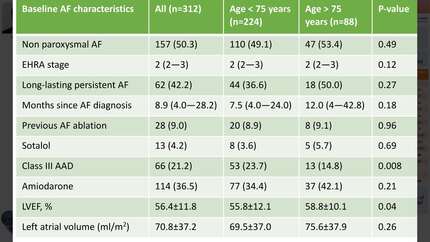
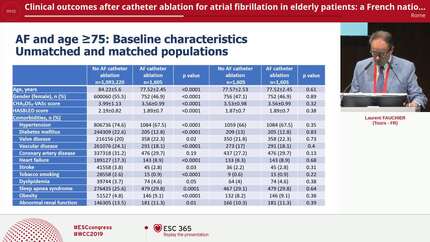
In total, 1160 patients were treated with the pentaspline PFA catheter. Grouped by age at the time of ablation, 158 (13.6%) subjects were ≥75 years old. The older patients were more frequently female (52.5% vs 30.0%; p<0.01), had higher rates of comorbidities including ischemic cardiomyopathy (7.6% vs 3.7%; p=0.02), myocardial infarction (7.0% vs 3.4%; p=0.03), COPD (7.0% vs 2.9%; p=0.01), and renal disease (11.4% vs 4.7%; p<0.01), and more often diagnosed with persistent AF (42.0% vs 31.2%; p<0.01). The elderly patient cohort more often had pulmonary vein (PV) isolation with additional extra-PV ablations (39.5% vs 25.5%, p < 0.01). Procedure and fluoroscopy times did not differ between groups despite differences in overall ablation strategy between groups. Early onset device- or procedure-related SAEs were reported in 4 patients in the elderly group versus 12 patients in the younger group (2.5% vs 1.2%; p = 0.18). To date, 659 (65.8%) patients <75 years old and 103 (65.2%) patients ≥75 years old have completed one-year follow-up. There was no difference in the Kaplan-Meier estimates for clinical effectiveness (≥75: 77.0% vs < 75: 78.9%, p=0.90)
In the FARADISE registry, procedural and one-year clinical outcomes were similar between patients ≥75 years old versus patients <75 years old. Acute safety event rates were not significantly larger in the elderly cohort. Notably, long-term clinical effectiveness remained similar for elderly patients compared with the younger cohort treated with the pentaspline PFA catheter.
Contributors



You may be interested in