Feasibility of very high-power, short-duration ablation with the QDOT Micro catheter: initial findings from the Q-POWER Study
European Heart Journal


Abstract
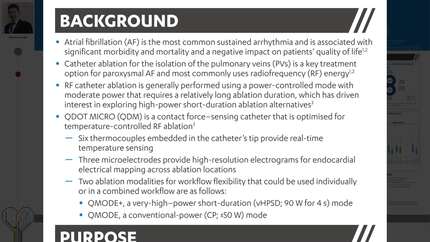
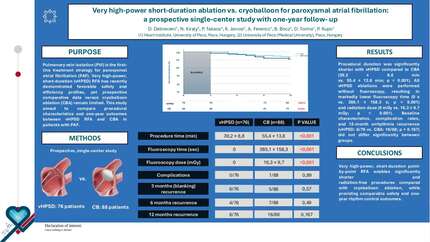
The QDOT MICRO catheter enables very high-power short-duration (vHPSD) radiofrequency (RF) ablation for pulmonary vein isolation (PVI) in atrial fibrillation (AF) patients.
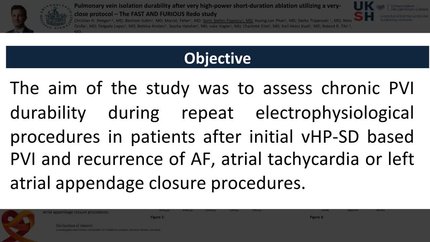
To evaluate vHPSD ablation on PVI duration (first to last RF), first pass isolation (FPI) rates, and pulmonary vein (PV) reconnection.
The Q-POWER study is a prospective single-center study including AF patients undergoing primary RF PVI. Initial circumferential ablation was conducted using the QDOT MICRO catheter solely in vHPSD (QMODE+,90W/4s)-settings using an inter-tag distance (ITD) of <4mm and partly <6mm on the posterior wall. Touch-up ablation was performed in QMODE (≤50W). After a waiting period of 30 min, durability of PVI was confirmed by bidirectional conduction block. If reconnection occurred, further ablation was performed until re-isolation.
Forty-one patients were included in the study (61 years; 68.3% male; 65.9% paroxysmal AF). The mean procedure time was 57.7 ± 29.4min, with fluoroscopy and RF times 9.8±4.2min and 8.3±3.0min, respectively. The mean number of QMODE+ applications was 88.5±1.9, with a median of 6[0-10] ablations performed in QMODE for cases without FPI or with PV reconnection. FPI was achieved in 56.1% of left PVs (LPV) and 43.9% of right PVs (RPV). Reconnection of the LPVs occurred in 34.1%, predominantly at the anterior carina (12.2%) and anterior and inferior segments of the left inferior PV (both 14.6%). Reconnection in the RPVs (29.3%) primarily occurred in the carina and posterior carina (both 14.6%) segments.
PVI solely using QMODE+ was associated with suboptimal FPI rates, often necessitating additional ablation. Reconnection was predominantly observed in the carina of both PV pairs and LPV ridge, raising concerns about the ability of QMODE+ to achieve transmural lesions in these regions. Long-term follow-up is essential to determine the durability of QMODE+ PVI outcomes.
Contributors





You may be interested in