Association between comprehensive management of cardiovascular comorbidities and the risk of stroke in patients with new-onset atrial fibrillation
European Heart Journal


Abstract
Current guidelines recommend comprehensive management of comorbidities and cardiometabolic risk factors for atrial fibrillation (AF) patients. However, data on how comprehensive cardiovascular management affects stroke risk in AF remains limited.
We aimed to evaluate the association between comprehensive management of cardiovascular comorbidities and the risk of ischemic stroke in patients with AF.
The Korean National Health Insurance Service-Health Screening database was utilized to identify patients newly diagnosed with AF from 2010 to 2018. Cardiovascular comorbidity control score (CV-CCS) was assigned on a three-tier scale across hypertension, diabetes mellitus, and dyslipidemia: 2 points for well-controlled, 1 for intermediate, and 0 for poorly controlled conditions. Hypertension control was defined by diastolic blood pressure (DBP): <70 mmHg (well-controlled, 2 points), 70–89 mmHg (intermediate, 1 point), ≥90 mmHg (poorly controlled, 0 points). Diabetes was assessed by fasting glucose: <100 mg/dL (well-controlled, 2 points), 100–125 mg/dL (intermediate, 1 point), ≥126 mg/dL (poorly controlled, 0 points). Low-density lipoprotein (LDL) levels evaluated dyslipidemia: <100 mg/dL (well-controlled, 2 points), 100–159 mg/dL (intermediate, 1 point), ≥160 mg/dL (poorly controlled, 0 points). Total scores ranged from 0 (poorly controlled in all) to 6 (optimal control in all). The association between CV-CCS and stroke risk was analyzed using multivariable Cox regression.
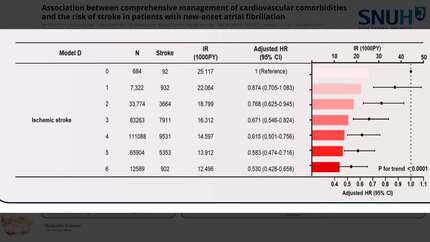
314,625 patients with newly diagnosed AF were included (mean age, 65.2±12.3 years; 57.6% men; mean CHA2DS2-VA score, 2.9±1.8). The CV-CCS ranged from 0 to 6, with patient counts of 684 (score 0), 7,322 (score 1), 33,774 (score 2), 83,263 (score 3), 111,088 (score 4), 65,904 (score 5), and 12,589 (score 6). The CV-CCS scores (0 to 6) were distributed as follows: 684 patients (0.22%) had a score of 0, 7,322 (2.33%) a score of 1, 33,774 (10.74%) a score of 2, 83,263 (26.46%) a score of 3, 111,088 (35.31%) a score of 4, 65,904 (20.95%) a score of 5, and 12,589 (4.00%) a score of 6. During a mean follow-up of 5.8±2.9 years, the incidence rate of ischemic stroke (per 1,000 person-years) was substantially lowered with higher CV-CCS scores, from 25.1 in the lowest score group (score 0) to 12.5 in the highest score group (score 6) (Figure 2). Patients with the highest CV-CCS score (6), indicating optimal comorbidity management, had a 47% lower ischemic stroke risk than those with a score of 0, reflecting poor control in all conditions (adjusted HR, 0.530; 95% CI, 0.428-0.658; P <0.001, Figure 1). A significant dose-response relationship was also observed (P for trend <0.001), with ischemic stroke risk decreasing progressively as CV-CCS scores increased.
This study demonstrates that better comprehensive comorbidities control, as reflected by higher CV-CCS scores, was associated with a significantly lower ischemic stroke risk in AF patients.
Contributors



G Y H Lip
Author
University of Liverpool Liverpool , United Kingdom of Great Britain & Northern Ireland
You may be interested in