Comparative analysis of atrial fibrillation risk in patients with vascular ehlers-danlos syndrome vs. marfan's syndrome
European Heart Journal


Abstract
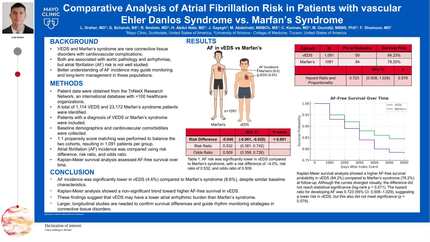
Vascular Ehlers-Danlos syndrome (VEDS) and Marfan’s syndrome are associated with cardiovascular complications, including arrhythmias. However, atrial fibrillation (AF) risk in these populations has not been frequently reported. This study assessed the AF risk in VEDS and Marfan's syndrome patients using propensity score-matched analysis from an international database.
The TriNetX Research Network, an international database with de-identified patient data from over 100 centers, was used to pull patients with a diagnosis of VEDS and Marfan's Syndrome. Baseline characteristics (e.g., demographics, cardiovascular comorbidities, etc.) were collected, and propensity score matching was performed to balance the cohorts. Rates of AF were collected across both cohorts, and risk analysis and Kaplan-Meier survival were used to assess outcomes.
A total of 1,114 and 23,172 patients had VEDS and Marfan’s syndrome, respectively. After propensity score matching, each cohort included 1,091 balanced patients regarding demographics and clinical characteristics. When compared in the matched cohorts, AF incidence was lower in VEDS (4.6%) compared to Marfan’s syndrome (8.6%), with a risk difference of -0.040 (95% CI: -0.061, -0.020; z = -3.794; p < 0.001). The risk ratio was 0.532 (95% CI: 0.381, 0.742), and the odds ratio was 0.509 (95% CI: 0.358, 0.726), indicating a significantly lower risk of AF in VEDS. Kaplan-Meier analysis showed an AF survival probability of 84.23% in VEDS and 78.20% in Marfan’s syndrome (log-rank p = 0.071). The hazard ratio was 0.723 (95% CI: 0.508, 1.029), which didn’t reach statistical significance (p = 0.579).
Patients with VEDS have a significantly lower risk of developing AF compared to those with Marfan’s syndrome. However, no significant difference in AF survival probability was observed. These findings suggest significant differences in the arrhythmic burden between these connective tissue disorders, which can direct future risk stratification and management strategies.
Contributors




You may be interested in