Association between fragmented QRS, myocardial scar burden and left ventricular function: a multimodality imaging study
European Heart Journal


Abstract
Fragmentation of the QRS complex (fQRS), left ventricular (LV) ejection fraction (LVEF), LV mass index (LVMi), global longitudinal strain (GLS), mechanical dispersion (MD), and myocardial scar burden have been linked to prognosis in various cardiac conditions. However, the relationships between these indices are not fully explored.
This study aimed to explore the association between fQRS and imaging metrics of LV function and myocardial scar burden.
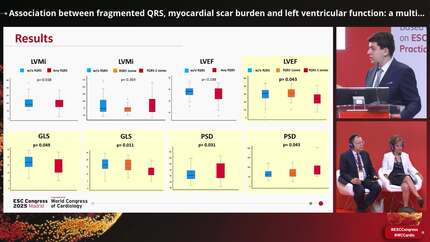
A cohort of 116 consecutive patients (mean age: 57±14 years, 69% male, mean LVEF: 57±17%) scheduled for cardiovascular magnetic resonance with late gadolinium enhancement (CMR-LGE) underwent echocardiography and ECG recording within one hour of CMR. fQRS was defined as the presence of an additional R wave (R′), notching at the nadir of the S wave, or multiple R′ waves in any ECG lead. LVEF and (Figure) LVMi were measured by CMR, while GLS and MD were assessed using speckle-tracking echocardiography. MD was calculated as the standard deviation of time-to-peak longitudinal strain across 17 LV segments. Myocardial scar burden was quantified using a five-point scale (0–4) to indicate the percentage of LGE in each segment, with scores of 3 and 4 representing transmural scar. The total scar burden score (TSBS) was the average of segmental scores.
At least one fragmented QRS complex was observed in 40.5% of patients who had a higher TSBS (0.44±0.77 vs. 0.15±0.42, p=0.04) and MD (79±34 vs. 65±23 ms, p=0.031), as well as lower GLS (14.4±4.9 vs. 16.6±4.5%, p=0.031), compared to those without fQRS. No significant differences were observed in LVEF (55±18 vs. 58±16%, p=0.325) or LVMi (79±26 vs. 82±26, p=0.528) between the groups. Patients with fQRS in two ECG regions exhibited significantly higher TSBS and MD, and lower GLS compared to those with fQRS in one region (p<0.05 for all). No significant differences in LVEF or LVMi were found based on the extent of fQRS.
It appaears that the presence and the extent of fQRS are linked to increased MD, higher myocardial scar burden, and reduced GLS. Our findings suggest that fQRS may serve as a more sensitive marker of myocardial alterations compared to conventional LV indices, such as LVEF and LVMi.
Contributors


K Grujicic
Author
A Ljubojevic
Author
I Vranic
Author
A Zivanic
Author
M Gajic
Author
M Jankovic
Author
B Gakovic
Author
M Panic
Author
P Milicevic
Author
S Kocic
Author
R Vidakovic
Author
A N Neskovic
Author
You may be interested in