Lipid core burden index and new LDL-C calculation in predicting non-culprit coronary events in very high-risk patients: Insights from the Lipid-Rich Plaque Study
European Heart Journal


Abstract
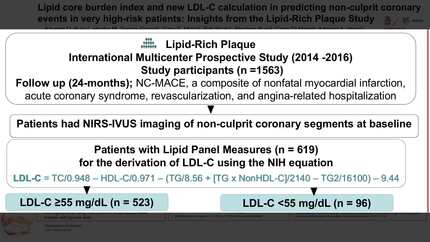
The European Society of Cardiology recommends an LDL-C threshold of <55 mg/dL for very high-risk patients. Lipid Core Burden Index (LCBI) per 4-mm coronary segment (maxLCBI4mm >400), assessed by near-infrared spectroscopy (NIRS)-intravascular ultrasound, predicts non-culprit major adverse cardiac events (NC-MACE). Investigating the association of LDL-C thresholds and NC-MACE in LCBI groups is warranted.
To evaluate the association between LDL-C very-high-risk threshold groups and NC-MACE, while investigating whether lipid-rich plaque burden measured by maxLCBI4mm further stratifies risk in very high-risk patients.
We analyzed data from an international multicenter prospective cohort (LRP Study, 2014-2016). Patients were stratified into high (maxLCBI4mm >400) and low (≤400) LCBI groups. LDL-C was calculated using the NIH equation. Spearman correlation assessed the relationship between maxLCBI4mm and LDL-C. NC-MACE, a composite of nonfatal myocardial infarction, acute coronary syndrome, revascularization, and angina-related hospitalization, was compared between LDL-C groups (≥55 mg/dL vs. <55 mg/dL) using Kaplan–Meier analysis with log-rank tests.
619 patients had baseline LCBI measurements and lipid panel data. The correlation between maxLCBI4mm and LDL-C was weakly positive (r = 0.063, p = 0.08). Among these patients, 523 had LDL-C levels ≥55 mg/dL, while 96 had LDL-C <55 mg/dL. Over a median follow-up of 2 years, the cumulative incidence of NC-MACE was 11% (n=66). In patients with LDL-C ≥55 mg/dL, NC-MACE incidence was significantly higher in those with maxLCBI4mm >400 compared to ≤400 (log-rank p < 0.001). In contrast, NC-MACE rates in patients with LDL-C <55 mg/dL were not significantly different by maxLCBI4mm groups.
Our findings indicate that lipid-rich plaque burden (maxLCBI4mm >400) predicts cardiovascular events even in patients with LDL-C ≥55 mg/Dl. These findings suggest that plaque composition, rather than LDL-C alone, plays a critical role in residual cardiovascular risk stratification. Integrating intracoronary imaging with lipid management strategies may enhance risk assessment and guide targeted therapeutic interventions across risk thresholds. Kaplan–Meier Curves
Contributors


H M Garcia-Garcia
Author
P Shah
Author


J J Wykrzykowska
Author
R Waksman
Author
Washington Hospital Center & Medstar Health Washington, DC , United States of America
You may be interested in