Empagliflozin reduces extracellular volume and myocardial sodium content in patients with heart failure and preserved ejection fraction and correlates with reverse cardiac remodeling (EMPAG CMR-HF)
European Heart Journal


Abstract
Extracellular volume (ECV) expansion and myocardial sodium overload are a major determinants of adverse remodeling in heart failure (HF). Cardiac magnetic resonance (CMR) has been developed as a noninvasive technique to estimate ECV and sodium tissue content. SGLT-2 inhibition blocks sodium reabsorption in renal proximal tubular cells with remarkable cardiovascular outcomes in HF due to mechanisms not yet fully understood.
The objective of this study is to assess the response to empagliflozin by measuring changes in ECV and myocardial sodium content and their association with reverse cardiac remodeling in patients with heart failure and preserved ejection fraction (HFpEF).
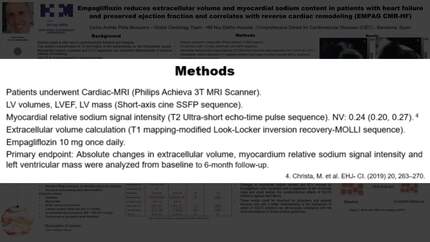
Prospective, single-center, open-label study of fifty nondiabetic outpatients with HFpEF underwent baseline CMR and initiated with empagliflozin 10 mg once daily according to GDMT. Absolute changes in ECV, myocardium relative sodium signal intensity (rSSI) and left ventricular mass index (LVMi) were analyzed from baseline and at 6-month follow-up with CMR.
All patients exhibited significantly high baseline MOLLI-ECV [38% ± 2.7], and high baseline myocardium rSSI [0.32 (0.28, 0.34)], decreasing to 29% ± 2.7 for ECV (P<0.001) and -30% for rSSI [0.27 (0.22, 0.30), P<0.001]. These changes were correlated with a significant reduction in LVMi of -13 g/m2 [from 84 g/m2 (72, 120) to 71 g/m2 (63, 95), P<0.001] at 6 months with empagliflozin therapy.
Empagliflozin reverses pathological hypertrophy in patients with HFpEF. These findings suggest that SGLT-2 inhibition acts directly on cardiomyocytes and explains the cardioprotective effects demonstrated through large, randomized trials.
Contributors

You may be interested in