Age, sex and ethnicity-stratified myocardial strain reference ranges from the healthy hearts consortium
European Heart Journal


Abstract
Myocardial feature-tracking (FT) strain from cardiovascular magnetic resonance (CMR) has incremental prognostic value beyond traditional imaging biomarkers. Clinical use is limited by the absence of population-specific healthy reference ranges. This study provides age-, sex-, and ethnicity-specific reference ranges for CMR-derived FT strain from the Healthy Hearts Consortium (HHC).
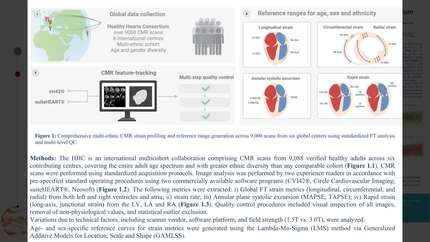
The HHC is an international collaboration comprising CMR scans from 9,088 verified healthy adults across six centres, covering the entire adult age spectrum and with diverse ethnic background. Standardised CMR acquisition protocols were used. Image analysis was performed by two experienced readers following pre-specified standard operating procedures and using two commercially available software platforms (cvi42®, Circle Cardiovascular Imaging Inc.; suiteHEART®, Neosoft LLC). The following metrics were extracted: i) global FT strain metrics from both ventricles (longitudinal, circumferential, and radial) and both atria (longitudinal); ii) strain rate; iii) Mitral/Tricuspid annular plane systolic excursion (MAPSE, TAPSE); iv) rapid strain (long-axis, junctional strain) from the left ventricle and both atria. Quality control included visual inspection of all images and the removal of biologically non-sensical values and extreme statistical outliers. Reference ranges were calculated by age group (deciles: 20-80 years), sex (male/female), and ethnicity (White, Black, Chinese, South Asian, Mixed/Other) using the 95% prediction interval method. Technical variations due to scanner vendor, software platform, and field strength (1.5T vs. 3.0T), were analysed.
The study included 4,452 men (49%) and 4,636 women (51%). Ages ranged from 18 to 83 (mean 61±13) years. The sample included diverse ethnic backgrounds [White (81.7%), South Asian (5.6%), Mixed/Other (5.3%), Black (3.7%), and Chinese (3.7%)]. Women demonstrated significantly higher absolute strain values than men across. Absolute myocardial strain values were higher in younger age groups and lower in older age groups, most notably in left global circumferential and longitudinal strain. Ethnic differences in strain were most pronounced between White and Black as well as between White and Chinese individuals regarding left and right ventricular strain values, while left and right atrial strain values as well as rapid strain values, were similar across ethnic groups.
This study provides comprehensive, population-specific reference ranges for FT-CMR-derived myocardial strain, addressing a clinical knowledge gap. These findings inform clinical interpretation, improving diagnostic accuracy and risk stratification in different populations. This work represents a significant step towards a broader clinical implementation of myocardial strain analysis in routine cardiovascular care, ensuring more accurate classification of findings across varying demographic groups.
Contributors

D G Condurache
Author
R Roy
Author
L Szabo
Author
T Akilu
Author
A M Salih
Author
University of Leicester Leicester , United Kingdom of Great Britain & Northern Ireland
S Chadalavada
Author
T Leiner
Author
C W L Chin
Author

M Doerr
Author


S E Petersen
Author
Queen Mary University of London London , United Kingdom of Great Britain & Northern Ireland

Z Raisi-Estabragh
Author
Queen Mary University of London London , United Kingdom of Great Britain & Northern Ireland
You may be interested in