Impact of an interactive CTCA/FFRCT interventional stent planning tool on patient management
European Heart Journal


Abstract
Fractional flow reserve (FFR) post percutaneous coronary intervention (PCI) is an important determinant of patient outcomes. A new virtual stent planning tool allows users to model PCI and obtain post PCI FFRCT.
We hypothesised that where a sub-optimal post PCI FFRCT was predicted theoretical management may be altered prior to invasive angiography.
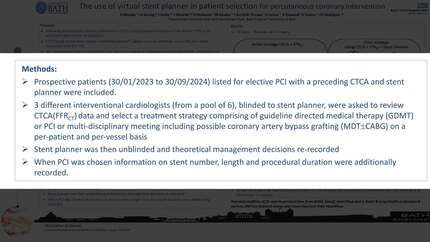
Single-centre retrospective review of patients listed for PCI with preceding CTCA(+FFRCT), (Jan 2023-Sep 2024). Interventional cardiologists (ICs) at our institution determined a theoretical management strategy of 1) medical therapy (GDMT) 2) PCI or 3) multi-disciplinary team meeting (MDT) ±coronary artery bypass grafting (CABG) on a per-patient and per-vessel basis. The virtual stent planning tool was then unblinded and decision making repeated. Changes to management were compared with Wilcoxon-signed rank test and inter-rater agreement with Fleiss’ free marginal kappa.
335 patients had a CTCA(+FFRCT), 96 clinically listed for angiography, 74 included in the study. 73% male, 66 ±11 years. On a per-patient basis using CTCA(+FFRCT) data PCI was chosen in 95% (70/74) of cases, GDMT in 4% (3/74) and MDT±CABG in 1% (1/74). The addition of the virtual planning tool changed management strategy to PCI in 59% (44/74) of cases, GDMT in 30% (22/74) and MDT in 11% (8/74), Wilcoxon-signed rank test P= .04.
In patients scheduled to undergo clinically indicated PCI with preceding CTCA(+FFRCT) the use of the virtual stent planning tool significantly altered ICs theoretical management strategy upstream of invasive angiography, with a reduction in PCI, predominantly in favour of GDMT.
Contributors

D Murphy
Author
Royal United Hospital Bath NHS Trust Bath , United Kingdom of Great Britain & Northern Ireland
A Gurung
Author
Royal United Hospitals, Bath Bath , United Kingdom of Great Britain & Northern Ireland
J Graby
Author
J Abramik
Author

D Mckenzie
Author
Royal United Hospital Bath NHS Trust Bath , United Kingdom of Great Britain & Northern Ireland
S R Kandan
Author
T Burchell
Author
R Lowe
Author
Royal United Hospital Bath NHS Trust Bath , United Kingdom of Great Britain & Northern Ireland
K Carson
Author
Royal United Hospital Bath NHS Trust Bath , United Kingdom of Great Britain & Northern Ireland
A Khavandi
Author
B Hudson
Author
J C L Rodrigues
Author
You may be interested in