ATTR cardiomyopathy is associated with a distinct radiomic profile of epicardial adipose tissue in patients with severe aortic stenosis
European Heart Journal


Abstract
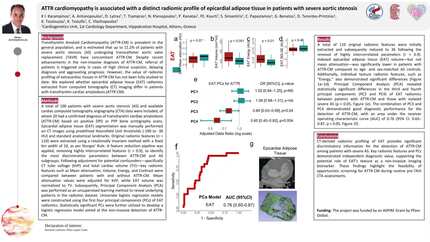
Epicardial adipose tissue (EpAT) constitutes a metabolically active fat repository with various endocrine and paracrine effects, playing a significant role in myocardial biology. We explored whether EpAT radiomics extracted from computed tomography (CT) imaging differ in patients with transthyretin cardiac amyloidosis (ATTR-CM).
This study included 78 patients with severe aortic stenosis (AS) and CT angiography datasets, of whom 14 were diagnosed with ATTR-CM (confirmed by positive DPD or PYP bone scintigraphy scan). Segmentations of EpAT on CT images were manually performed with predefined thresholds (-190 to -30HU) and standard anatomical hallmarks. Original radiomic features were extracted using a rotationally invariant method with a bin width of 10, complying with the Sturge-Weber rule. A feature reduction process was applied including removal of highly intercorrelated features to identify key discriminatory features between ATTR-CM and AS patients. Unsupervised learning methods including Principal Component Analysis (PCA) were performed to explore patterns in the data.
A total of 107 original radiomic features were extracted, which were reduced to 41 after removal of highly intercorrelated variables. In principal component analysis there were statistically significant differences for PCA-2 and PCA-4 scores between ATTR-CM+AS and AS patients (p<0.05, panels a-b). The combination of EpAT radiomics PCA-2 and PCA-4 had good diagnostic performance for ATTR-CM classification (AUROC 0.79, 95%CI: 0.67-0.91, p<0.05, panel c).
EpAT imaging texture differs in patients with AS and ATTR-CM compared to patients with AS only. These findings suggest that EAT may be directly involved in the parthophysiology of ATTR-CM or be a marker of advanced heart failure in these patients.
Contributors


D Lytras
Author

N Ktenopoulos
Author
P Kanatas
Author
F E Kourti
Author
S Simantiris
Author
C Papastamos
Author
G Benetos
Author
D Terentes-Printzios
Author
K Toutouzas
Author
K Tsioufis
Author

You may be interested in