Epicardial fat increase over time after lung transplantation
European Heart Journal


Abstract
Epicardial fat (EF) has gained attention as indicator of cardiovascular disease and is believed to play a role in the development of coronary artery disease. Post-transplantation immunosuppression is known to increase cardio-metabolic risk factors, such as obesity, diabetes and hypertension. It remains unknown whether these cardio-metabolic changes also effect the amount of EF.
To measure changes in EF over six years in lung transplantation (LTx) patients.
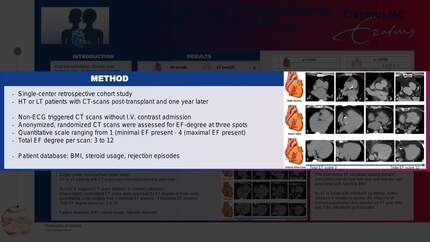
We included LTx patients with CT-scans post-transplant and annual follow-up CT scans up to six years. Anonymized scans were scored in random order for the amount of EF by two independent observers at three pre-defined locations, using a 4-point scale (1[minimal EF present]-4[maximum EF present] per location. This results in a total EF score ranging from 3-12, as shown in Figure 1. In cases of disagreement between the observers, a consensus score was determined. Baseline patient characteristics were extracted from the patient database. EF progression over time was analyzed using a linear mixed model, adjusted for BMI.
We included 137 LTx patients, with a median age of 60 [IQR53-64] years at transplantation, of whom 62 (45%) were female. Baseline CT was used as the reference for the amount of EF and was conducted at a median time of 19 [IQR14-32] days post-LTx. Details on time between LTx and follow-up CT scans, total EF score on CT and BMI at time of CT are provided in Table 1.
EF increased by a mean of 2.6 points (95%CI 2.0-3.2) over six years (p<0.001). After adjusting for BMI, the increase was 2.1 points (95%CI 1.5-2.9) over six years (p<0.001).
Epicardial fat increased significantly over six years in LTx recipients, even after adjusting for BMI. These findings suggest that post-transplant factors may contribute to EF progression and potentially influence cardio-metabolic risk. Understanding EF progression post-transplantation may benefit long-term clinical outcomes. EF score on CT EF progression during follow-up
Contributors



You may be interested in