Three-dimensional echocardiographic left atrial emptying fraction (3D LAEF) compared with traditional and novel diastolic dysfunction parameters in patients with chronic heart failure
European Heart Journal


Abstract
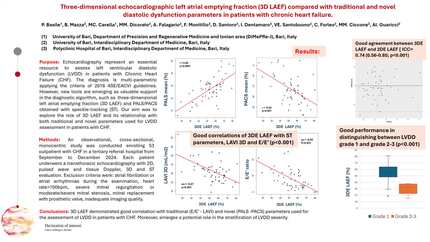
Echocardiography represent an essential resource to assess left ventricular diastolic dysfunction (LVDD) in patients with Chronic Heart Failure (CHF). The diagnosis is multi-parametric by applying the criteria of 2016 ASE/EACVI guidelines. Alongside the traditional parameters adopted, new tools are emerging as valuable support in the diagnostic algorithm. Among these, the most remarkable are three-dimensional left atrial emptying fraction (3D LAEF) and PALS/PACS obtained with speckle-tracking (ST). However, their role in daily practice requires further investigations.
Our aim was to explore the role of 3D LAEF and its relationship with both traditional and novel parameters used for LVDD assessment in patients with CHF.
An observational, cross-sectional, monocentric study was conducted enrolling 53 outpatient with CHF in a tertiary referral hospital from September 2024 to December 2024. Exclusion criteria were the presence of any of the following: atrial fibrillation or atrial arrhythmias during the examination, heart rate>100bpm, severe mitral regurgitation or moderate/severe mitral stenosis, mitral replacement with prosthetic valve, inadequate imaging quality. For each patient were collected clinical data and a transthoracic echocardiography with 2D, pulsed wave and tissue Doppler, 3D and ST evaluation were performed by two cardiologists with expertise in advanced echocardiography.
The mean age of the population was 66±11 years with a clear prevalence of male sex (83%). About one half of patients had a HFrEF (43%), 32% of cases had HFmrEF and the remaining HFpEF (25%). The median value of 3D Left Atrial Volume Index (LAVI) was 32 (IQR 12). According to the criteria ASE/EACVI, the majority of the population had a grade 1 LVDD (90%), while a grade 2 and 3 were found respectively in 6% and 4% of cases. Statistically significant correlations were found between 3DE LAEF and 3D LAVI (ρs = -0.47; p<0.001), 2D LAVI (ρs = -0.46; p = 0.001), E/E’ (ρs = -0.55; p< 0.001) and 2D LAEF (r = 0.74; p<0.001). Furthermore, a statistically significant correlation was found between 3DE LAEF and ST parameters [PALS (r = 0.69; p<0.001) - PACS (r = -0.52; p<0.001)]. A direct comparison between LAEF measurement obtained with 3D and 2D revealed a good agreement with an ICC of 0.74 (0.56-0.85; p<0.001) and a mean difference between measurements of 4%. Moreover, patients were categorized in two groups according to the severity of LVDD (grade 1 vs grade 2-3) and a statistically significant difference was found regarding 3DE LAEF (55±13 vs 31±9; p<0.001).
3D LAEF demonstrated good correlation with traditional (E/E’ - LAVI) and novel (PALS -PACS) parameters used for the assessment of LVDD in patients with CHF. Moreover, emerges a potential role in the stratification of LVDD severity. Further studies are required to better elucidate the potentiality of this novel tool in clinical practice.
Contributors


M C Carella
Author

A Falagario
Author
The Department of Emergency and Organ Transplantations of the University of Bari Bari , Italy
D Santoro
Author
I Dentamaro
Author
V E Santobuono
Author
A I Guaricci
Author
You may be interested in