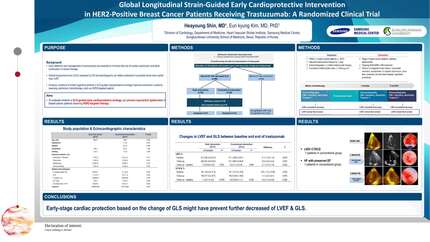
Global longitudinal strain-guided early cardioprotective intervention in HER2-positive breast cancer patients receiving trastuzumab: a randomized clinical trial
European Heart Journal


Abstract
Early detection and management of cardiotoxicity by anticancer agents are important to reduce the risk of cardiac dysfunction and continue their cancer treatment. Although global longitudinal strain (GLS) by 2D echocardiography can identify subclinical myocardial dysfunction, there is limited data on whether the GLS-guided early cardiac protection in patients who received cardiotoxic chemotherapy is beneficial. This study evaluates the effectiveness of GLS-based early cardioprotective strategy to reduce myocardial dysfunction in breast cancer patients receiving HER2-targeted therapy.
This single-center prospective randomized clinical trial included 140 HER2-positive breast cancer patients receiving adjuvant trastuzumab. Among them, 80 patients with normal left ventricle ejection fraction (LVEF) but decreased GLS were randomly assigned to the GLS-guided early intervention group (angiotensin-receptor blocker (ARB) when GLS decreased >15% or absolute value < 18%) and EF-guided conventional intervention group (candesartan administration only when LVEF < 50%). The primary endpoint was the between-group change in LVEF from baseline to up to 6 months after finishing all trastuzumab schedules. The secondary endpoint was the development of symptomatic heart failure.
Patients were 51±10 years of age, with no significant difference between the two groups. Cardiac risk factors such as hypertension, diabetes, or dyslipidemia were not statistically different. About 43% of the enrolled patients received anthracycline-based chemotherapy before the administration of trastuzumab with no significant difference between the early intervention group and the conventional intervention group (36.1% vs. 50.0%, p=0.248). At baseline, only GLS values showed significant differences between the two groups (early intervention group 16.7±1.0% vs. conventional intervention group 16.1±1.4%, p=0.036). One year after completion of trastuzumab administration, the early intervention group showed significant improvements in both LVEF (from 61.3% to 62.9%, p=0.043) and GLS (from 16.7% to 18.0%, p<0.001), while the conventional intervention group showed improvement only in GLS (from 16.1% to 16.9%, p=0.045) with no significant change in LVEF (p=0.604). However, direct comparison of the changes in LVEF and GLS between the two groups revealed no statistically significant differences (LVEF difference: -0.7%, p=0.565; GLS difference: -0.5%, p=0.368). Overt heart failure occurred in only one patient in the conventional intervention group.
Although there were no significant differences in LVEF and GLS changes between early and conventional intervention groups, GLS-based early cardioprotective medication demonstrated a trend to prevent further decline in LVEF in patients who received cardiotoxic anticancer treatment. Future data is needed to identify specific groups who will benefit from this early-cardioprotective strategy.

You may be interested in