Advanced echocardiographic analysis in identifying significant coronary artery disease
European Heart Journal


Abstract
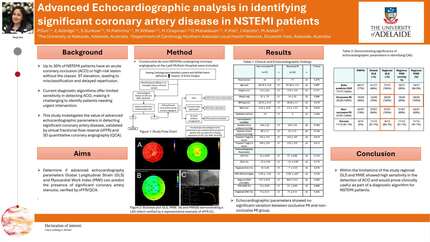
Approximately 30% of patients presenting with NSTEMI have an acute coronary occlusion (ACO) and or high-risk lesions requiring prompt intervention, however accurate diagnosis using the current clinical algorithm can prove difficult. Therefore, it is challenging to distinguish which patients require immediate intervention versus early invasive strategy.
This study aims to investigate the value of non-invasive diagnostic advanced echocardiography measures in detecting significant coronary artery disease, assessed via virtual fractional flow reserve (vFFR) and 3D quantitative coronary angiography (QCA).
Participants with NSTEMI requiring coronary angiography (N=24) received an echocardiogram, where myocardial work index (MWI), myocardial constructive work (MCW), myocardial wasted work (MWW), myocardial work efficiency (MWE), left atrial (LA) strain and right ventricular (RV) strain were measured. This was followed by an invasive coronary angiogram, involving vFFR and 3D QCA analysis. Mean age was 61(± 12.69)years, mean initial troponin was 163.19ng/L (± 201.50),increasing to 299ng/L (±389.98) at 3 hours. Of the participants, 22/24 (92%) yielded a vFFR value <0.8, which correlated with a territorial mean GLS value of -8% (±5.30), MWI 1048mmHg% (±423.82) and MWE of 77% (± 16.92). Territorial GLS segments showed a moderate negative correlation with territorial MWI segments (r=-0.52, p<0.05) and vFFR of the mid and distal LAD (r=-0.543, p<0.05), (r=-548, p<0.05). Notably, territorial MWE exhibited a significant positive correlation with territorial segments of MWI (r=-.707, p<0.001).
Preliminary results demonstrate the potential utility of extended echocardiogram measures in distinguishing between NSTEMI patients requiring immediate or delayed intervention. Myocardial work index Virtual Fractional Flow Reserve
Contributors


S Surikow
Author
M Pathirina
Author
M Wittwer
Author
M Chapman
Author
G Mahadavan
Author
P Purendra
Author
You may be interested in