Predictive value of left atrial appendage emptying fraction for functional decline and thrombus formation: a prospective 1-year tee study
European Heart Journal


Abstract
Left atrial appendage (LAA) function plays a key role in thrombus formation. While the association between low emptying velocities and thrombi is well established, the prognostic significance of impaired LAA emptying fraction, even in the presence of normal velocities, remains unclear. This study aimed to evaluate whether low LAA emptying fraction is associated with progressive functional deterioration and thrombus formation at 1 year.
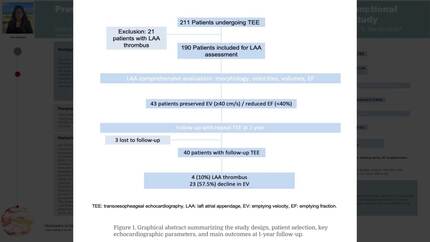
We conducted a prospective study including 211 consecutive patients who underwent transesophageal echocardiography (TEE) for various indications between September 2021 and December 2023. Twenty-one patients with documented LAA thrombus at baseline were excluded. In the remaining 190 patients, comprehensive LAA assessment was performed, including morphological classification, measurement of LAA emptying and filling velocities, LAA end-diastolic and end-systolic volumes, and calculation of the LAA emptying fraction (EF) using 45° and 130° views.
Patients with normal emptying velocities (≥40 cm/s) but low LAA EF (<40%) were identified and followed prospectively. Repeat TEE was performed at 1 year. The primary endpoint was the incidence of de novo LAA thrombus. The secondary endpoint was the progression to low LAA emptying velocities (<40 cm/s).
Among the 190 patients, 94 (32.4%) had low LAA emptying velocities at baseline. Forty-three patients (14.8%) had preserved emptying velocities but low LAA EF and were included in the follow-up cohort. After 1 year, 3 patients were lost to follow-up, and 2 ischemic strokes were documented (1 in a patient with a mechanical aortic prosthesis and 1 in a patient with atrial fibrillation). Among the 40 patients who completed the follow-up TEE, 4 (10%) developed de novo LAA thrombus. Additionally, 23 patients (57.5%) experienced a decline in LAA emptying velocities to <40 cm/s. Patients with low baseline EF were more likely to show progressive functional deterioration of the LAA, even in the absence of initial velocity abnormalities (illustrated in the graphical abstract in picture 1).
Low LAA emptying fraction, even in patients with normal baseline emptying velocities, is associated with progressive functional deterioration and an increased risk of thrombus formation at 1 year. Combining mechanical and functional assessment of the LAA may improve risk stratification and guide anticoagulation strategies in patients undergoing TEE. Graphical abstract
Contributors


M A Salem
Author
S Ouabdesselam
Author
D Saidouamer
Author
A Haddad
Author
A Azaza
Author
O Aitmokhtar
Author
B Djafer
Author
You may be interested in