Eicosapentaenoic acid limits the more rapid oxidation of lipoprotein(a) compared with other apolipoprotein B particles
Cardiovascular Research


Abstract
Elevated lipoprotein(a) [Lp(a)] levels increase cardiovascular (CV) risk. Lp(a) contains oxidized phospholipids that may promote lipid oxidation more than other lipoproteins. The highly unsaturated omega-3 fatty acid eicosapentaenoic acid (EPA) has multiple double bonds that can trap free radicals in resonance structures. Purified ethyl-EPA reduced CV events in high-risk patients with elevated Lp(a) despite Lp(a)-associated risk elevation. Since Lp(a) is enriched in oxidized lipids, we hypothesized that Lp(a)-enriched plasma undergoes more rapid oxidation than other apolipoprotein B (ApoB)-containing particles and that EPA limits oxidation of Lp(a)-enriched plasma more effectively than less-unsaturated fatty acids or other lipid-lowering treatments. This property could limit the cellular stress responses in endothelial cells (ECs).
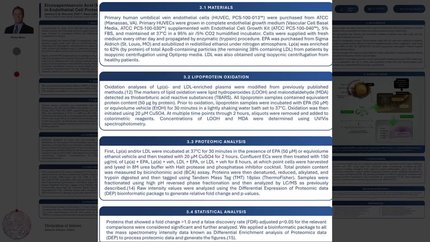
Lp(a) was enriched to >50% total ApoB content to resemble an Lp(a)-associated ‘high-risk’ phenotype and compared with matching levels of small-dense LDL (sdLDL) and very-low-density lipoprotein by isopycnic centrifugation. Samples were then incubated with EPA (50 µM) or equivolume vehicle at 37°C for 30 min. Oxidation was initiated with copper sulfate and monitored by malondialdehyde formation. We also subjected EPA to oxidation before measuring its antioxidant activity when compared with other long chain, less saturated fatty acids and lipid-lowering agents. Human umbilical vein ECs (HUVECs) were incubated with Lp(a)-enriched plasma following oxidation in the absence and presence of EPA. Cell lysate samples were then analysed by global liquid chromatography-mass spectroscopy (LC/MS)–based proteomics for significant changes in protein expression (>1-fold). Lp(a)-enriched plasma contained the highest baseline oxidized lipid (
Lp(a)-enriched plasma underwent more rapid oxidation than other ApoB-containing lipoproteins and promoted inflammatory changes in EC protein expression, a process attenuated by EPA. This action may contribute to reduced CV risk by EPA in those with elevated Lp(a) levels.
Contributors

Peter Libby
Author
Richard L Dunbar
Author

Deepak L Bhatt
Author
Icahn School of Medicine at Mount Sinai New York City , United States of America

R Preston Mason
Author
Brigham and Women's Hospital and Brigham Health Boston , United States of America
You may be interested in